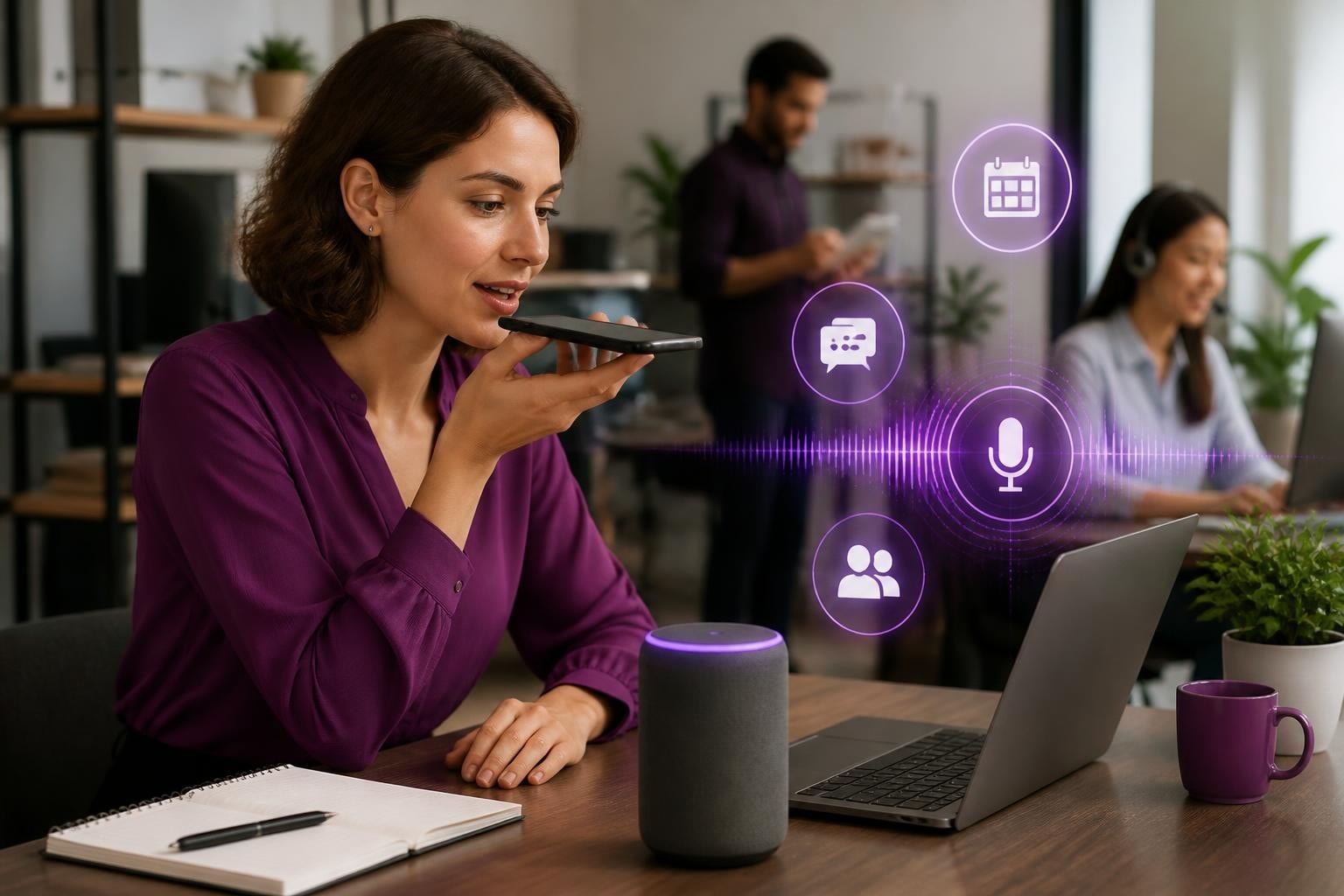
An intelligent agent in artificial intelligence is a system that senses its environment, makes a decision, and acts to reach a goal, with little or no human help. Common intelligent agent in artificial intelligence examples include a thermostat, a self-driving car, a spam filter and a chatbot that qualifies sales enquiries.
If that sounds abstract, it shouldn't. You already use agents every day. The trick is spotting which ones could save your business time.
What does an intelligent agent actually do?
An intelligent agent runs a simple loop: perceive, decide, act. It takes in information through sensors (a camera, a form submission, a sales database), picks the action most likely to hit its goal, then does it through actuators (sending an email, moving a robot arm, booking a slot).
Think of a good receptionist. They notice a call coming in, decide who it's for, and route it. An agent does the same job, only it never gets tired and never forgets to follow up.
Four traits mark out a proper agent:
- Autonomy: it works without constant instructions.
- Perception: it reads its environment, whether that's a room, a website or an inbox.
- Goal-driven behaviour: it aims at something specific, like a booked appointment.
- Learning or adaptation: the better ones improve with feedback.
Agents are also measured against a performance standard. A parcel-sorting agent is judged on speed and accuracy, not on how clever it sounds.

What are good examples of AI agents?
Good examples of AI agents range from a basic thermostat to a self-driving car, and the right one to look at depends on how much the agent has to think.
Here's a quick tour, from simplest to smartest:
- Thermostat: senses temperature, switches heating on or off. No memory, no planning.
- Automatic door sensor: detects movement, opens the door.
- Spam filter: reads incoming mail, decides junk or not, and improves as you mark mistakes.
- Satnav apps: hold a goal (your destination), weigh routes and reroute around traffic.
- Voice assistants: take a spoken request and pick actions to meet it. We cover this in more detail in our piece on whether Siri is artificial intelligence.
- Self-driving cars: juggle safety, speed, comfort and legality all at once.
- Warehouse robots: map their surroundings and avoid collisions while moving stock.
Notice the pattern. Agents that balance more variables generally need a more sophisticated design.
What are the 5 types of agent in AI?
The five classic types of agent in AI are simple reflex, model-based reflex, goal-based, utility-based and learning agents. Each adds a bit more thinking power to the one before.
| Type | How it decides | Example |
|---|---|---|
| Simple reflex | Reacts to what it sees right now | Thermostat |
| Model-based reflex | Keeps an internal picture of the world | Smart security system tracking which doors are open |
| Goal-based | Plans steps towards a target | Satnav route planning |
| Utility-based | Weighs trade-offs to find the best outcome | Energy system balancing cost and comfort |
| Learning | Improves from experience | Recommendation engine, spam filter |
If you want a deeper walk-through, our guides on the types of intelligent agent in AI and the goal-based agent in AI go further.
Is ChatGPT an example of agentic AI?
ChatGPT on its own is a conversational model rather than a full agent, but it becomes agent-like when it's connected to tools and given a goal to pursue. A chat that only answers questions waits for you every time. An agent built on the same technology can check your calendar, draft a reply, send it and log the result.
That distinction matters when you're buying. Plenty of products get labelled "AI agent" when they're really a chatbot with a nice name. A quick test: does it take actions on your behalf, or does it only talk?

Intelligent agent in artificial intelligence examples for small businesses
For a small business, the most useful agents handle one repetitive job well, such as answering enquiries, qualifying leads or booking appointments. You don't need a robot army. You need a dependable assistant for the task that eats your week.
Here's how that looks across different sectors:
- Trades: an agent replies to a web enquiry within seconds, asks for the postcode and job type, and offers a survey slot. No more calling back from the van.
- Retail and eCommerce: an agent answers "where's my order?" questions by checking your order system, and flags abandoned baskets for a nudge.
- Recruitment: an agent screens incoming CVs against a brief and shortlists candidates for a human to review. Our piece on AI in hiring covers where to keep a person in the loop.
- Professional services: an agent captures a new client's details, checks them against your criteria and books a discovery meeting.
The results can be real. Platinum Components, one of our clients, saves 5-10 hours a week with its pricing platform, and an ecommerce client reports a 50% increase in sales.

Why intelligent agents matter for business right now
Agents matter because businesses of every size are adopting them to cut admin and speed up decisions. In PwC's May 2025 survey of 308 US business executives, most said AI agents were already being adopted in their companies. IBM's research found that most respondents expected AI agents to improve process efficiency and output by 2026, and many named better decision-making as a leading benefit.
Those are bigger-company numbers, but the direction is clear. Customers now expect quick replies, and an agent is often the cheapest way to deliver them. If you're curious about the wider picture, our look at the future of artificial intelligence is a good next read.
How to start using an agent in your business
The easiest way to start is to pick one painful, repeatable task and automate only that. Resist the urge to "do AI" across everything at once.
- List your time-eaters. Write down tasks you repeat daily, such as answering the same questions or chasing leads.
- Pick the one with a clear outcome. "Book more appointments" is measurable. "Be more innovative" isn't.
- Decide what the agent can do alone and when it hands over to you. Pricing disputes, complaints and anything sensitive should reach a human.
- Start small and check the results weekly. Look at replies, bookings and mistakes, then tweak.
- Expand only once it's proven.
Security and trust deserve a thought too. NIST has launched an AI Agent Standards Initiative focused on voluntary guidance, interoperability, agent identity and authentication, and security evaluation, which shows how seriously the area is being taken. Ask any supplier how their agent handles your customer data.
If you'd like help, AI Agents for Small Business is a practical agent built around one high-impact task, such as responding to enquiries, qualifying leads or booking appointments. And we'll tell you honestly if AI isn't the right answer for a particular job.
FAQ
What are some examples of intelligent agents in AI?
Typical examples include thermostats, spam filters, satnav apps, voice assistants, self-driving cars and warehouse robots. In business, enquiry-handling chatbots and lead-qualifying assistants are the most common.
What is the difference between an intelligent agent and a chatbot?
A chatbot mainly converses, while an intelligent agent perceives, decides and acts towards a goal. Some chatbots are agents, particularly when they book appointments or update records. Many are simply scripted question-and-answer tools.
Do small businesses need a custom-built agent?
Not always. Many jobs can be handled by configuring existing tools, which keeps costs low and avoids heavy development. A short discovery conversation will usually show whether a tool, an automation or a bespoke agent fits best.
Your next step is to write down the one repetitive task that costs you the most hours each week, because that's your best candidate for an agent. If you'd like an honest view on whether AI suits it, AI 4 Small Business lets you book a free 30-minute discovery call with no sales pressure, and our results guarantee means you don't pay if we can't find clear ways to save you time or improve how you run things. With over 15 years in AI and small business strategy, we'll help you pick the right tool, build it around how you already work, and measure what it delivers.