Implementing AI in business doesn't require a computer science degree or a massive budget. If you're running a small business, you might think artificial intelligence is only for tech giants with endless resources. That's simply not true anymore. Today's AI tools are designed for everyday business owners who want to work smarter, save time, and serve customers better. The key is starting small, choosing the right tools, and focusing on real problems your business faces right now.
Understanding What AI Can Actually Do for Your Business
Before implementing AI in business, you need to know what it can genuinely help with.
AI excels at repetitive tasks that follow patterns:
- Answering common customer questions
- Scheduling appointments and sending reminders
- Sorting through emails and prioritizing messages
- Managing inventory levels based on sales trends
- Creating first drafts of social media posts or product descriptions
Think about Sarah, who runs a local bakery. She spent three hours each week responding to the same questions on social media: "Do you do gluten-free?" "What are your opening hours?" "Can I order a custom cake?" Now she uses a simple AI chatbot that handles these queries instantly, freeing her to focus on actual baking.
Common Misconceptions That Hold Small Businesses Back
Many small business owners worry about things that aren't actually problems. You don't need to understand how AI works "under the hood" any more than you need to understand combustion engines to drive a car. You don't need to hire data scientists or invest in expensive hardware.
What you do need is clarity about what you're trying to solve. Understanding the benefits of AI for business starts with identifying your biggest time drains and bottlenecks.

Starting Your AI Journey: The First Steps
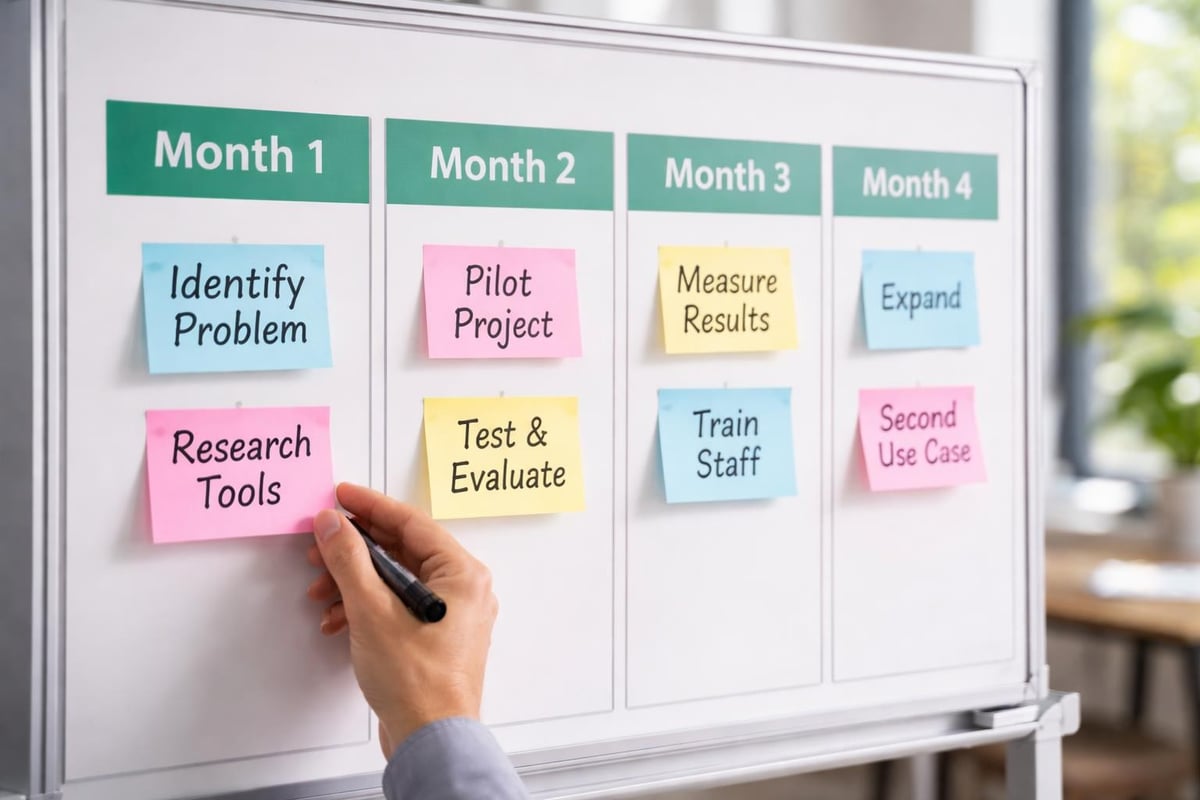
Implementing AI in business successfully means beginning with one specific problem, not trying to automate everything at once.
Pick One Pain Point
What task makes you groan every time you have to do it? What keeps you working late or prevents you from focusing on growth? That's your starting point.
Common first AI projects for small businesses:
| Business Type | First AI Implementation | Expected Time Saving |
|---|---|---|
| Retail shop | Chatbot for FAQs | 5-10 hours/week |
| Service business | Automated appointment booking | 3-7 hours/week |
| E-commerce | Product description generator | 4-8 hours/week |
| Restaurant | Review response automation | 2-5 hours/week |
Let's say you run a plumbing business. You're constantly interrupted by calls asking for quotes on standard jobs. An AI phone assistant can gather the basic information (property type, issue description, preferred times) and either provide immediate price estimates for common jobs or book appointments in your calendar. This approach to AI for business automation tackles a real problem immediately.
Choose Tools That Make Sense
Forget complex platforms that require months of setup. Look for AI tools specifically designed for small businesses that you can start using within days, not months.
For customer service, tools like Tidio or Chatfuel let you create chatbots without coding. For scheduling, Calendly with AI features handles bookings automatically. For content creation, tools like Jasper or Copy.ai help draft marketing materials.
The practical implementation of AI doesn't mean buying the most advanced system available. It means finding tools that solve your specific problems affordably.
Getting Your Team On Board
Your staff might worry that implementing AI in business means replacing them. Address this head-on.
Frame AI as a helpful assistant, not a replacement:
- It handles boring, repetitive tasks
- It frees them for more interesting work
- It makes their jobs easier, not redundant
When Tom introduced AI email sorting at his marketing agency, his team was skeptical. He showed them how much time they'd save not manually categorizing hundreds of emails daily. Within a week, they were suggesting other processes to automate. According to best practices for integrating AI in business, getting team buy-in early dramatically increases success rates.

Testing and Measuring Results
Don't just assume your AI implementation is working. Track actual results.
Set Clear Metrics Before You Start
- Time saved: How many hours per week did this task take before AI?
- Money saved: What's your hourly rate or your employee's wage for those hours?
- Quality maintained: Are customers still getting good service?
- New opportunities: What can you do with the time you've freed up?
Keep it simple. Create a spreadsheet with "before" and "after" numbers. If your chatbot answers 50 customer questions per week that previously took 15 minutes each, that's 12.5 hours saved weekly. At £20 per hour, that's £250 saved every week, or roughly £13,000 annually.
Research on AI implementation best practices emphasizes that small businesses succeed when they measure real-world impact, not just technical metrics.
Avoiding Common Mistakes
Implementing AI in business goes wrong when you skip these crucial steps.
Don't do this:
- Buy tools before identifying the problem
- Choose AI because competitors are doing it
- Expect perfection immediately
- Set it up once and never review it
- Try to automate everything at once
Do this instead:
- Start with your biggest frustration
- Test with a small project first
- Plan for gradual improvement
- Review performance monthly
- Expand slowly based on results
Scaling Up Gradually
Once your first AI project proves successful, you can expand thoughtfully.
Look at processes that are similar to what's already working. If your customer service chatbot succeeds, maybe add AI for appointment confirmations. If your email sorting works well, perhaps try AI-assisted response drafting.
Many AI case studies show that small businesses succeed by adding one new AI capability every quarter, not by rushing to automate everything simultaneously.
Building Without Creating Dependency
Here's something crucial: you want AI that enhances your business, not one you can't operate without.
Choose tools that complement your existing processes rather than replacing them entirely. Your AI chatbot should handle routine questions, but complex issues should still reach a human. Your AI scheduling tool should suggest appointment times, but you should be able to manually override when needed.
This balanced approach means if an AI tool stops working or becomes too expensive, your business continues functioning. You've gained efficiency, not created a critical vulnerability.
Handling Data and Privacy Concerns
You're probably handling customer information. Take this seriously.
Basic data protection with AI tools:
- Only share information the AI actually needs
- Use tools that comply with UK data protection laws
- Tell customers when they're interacting with AI
- Keep sensitive data (financial info, health records) out of most AI systems
- Review your AI provider's security policies
A café owner using AI to manage loyalty rewards doesn't need to feed the system customers' full addresses or phone numbers if email addresses suffice. Minimize data sharing as a standard practice.
The guidance on implementing AI with careful planning stresses that trust, once lost, is nearly impossible to regain.
Understanding Costs Realistically
Implementing AI in business doesn't have to drain your budget.
Many AI tools offer free trials or freemium versions. Test before committing. A chatbot might cost £20-50 monthly. An AI scheduling assistant might run £10-30 monthly. Content generation tools range from £30-100 monthly depending on usage.
Compare these costs against the time saved. If you're saving 10 hours weekly at a £25 hourly value, that's £1,000 monthly in saved time. Even a £100 monthly AI tool delivers tremendous ROI.
For specific pricing guidance, check out detailed information on the costs of AI for small businesses.
Finding the Right Support
You don't have to figure this out alone.
Look for AI providers who offer proper onboarding, training videos, and responsive support. Many small-business-focused AI companies provide free consultation calls to help you identify the right starting point.
Reading through AI business FAQs can answer common questions before you invest time in detailed research. You'll often find that concerns you have are shared by other business owners and have straightforward solutions.
Implementing AI in business is no longer optional for small businesses wanting to stay competitive, but it doesn't have to be complicated or expensive. Start with one clear problem, choose simple tools, measure your results, and expand gradually. If you're ready to explore which AI solutions make sense for your specific business, AI 4 Small Business offers practical, sector-specific guidance that helps you implement automation tools quickly without creating dependency. Their tailored approach ensures you get real value from AI without the complexity or costs of enterprise solutions.