You know that sinking feeling when a client doesn't show up, or when you realise you've forgotten to follow up with someone who seemed really interested? Yeah, we've all been there. The truth is, scheduling and customer follow-up might not be the most glamorous parts of running a business, but they're absolutely critical to keeping your revenue flowing and your customers happy. And here's the good news: this is exactly the kind of repetitive, time-consuming work that AI can handle brilliantly.
Why Scheduling and Customer Follow-Up Actually Matters
Let's be honest-missed appointments cost you money. Empty slots in your calendar mean lost revenue, and poor follow-up means potential customers slip through your fingers. Research shows that behavioural interventions like automated reminders significantly reduce no-shows, which matters whether you're running a plumbing business or a marketing consultancy.
But it's not just about preventing losses. Good scheduling and customer follow-up builds trust and professionalism. When a customer books easily, receives timely reminders, and gets a thoughtful check-in after their service, they feel valued. That's what turns one-time buyers into loyal fans who recommend you to others.
The Real Cost of Manual Processes
Think about how much time you spend on scheduling right now:
- Playing phone tag to find a time that works
- Sending confirmation texts or emails
- Manually entering appointments into your calendar
- Remembering to send reminders
- Chasing up no-shows
- Following up after the job's done
If you're spending even an hour a day on this stuff, that's five hours a week you could be spending on actual revenue-generating work. For most small businesses, that's thousands of pounds of lost productivity every year.
Practical Tools That Actually Work
You don't need some massive enterprise system to fix this. There are brilliant tools out there built specifically for small businesses, and many integrate with systems you're probably already using.
Self-Service Booking Systems
Modern booking platforms let customers schedule themselves 24/7. They can see your availability, pick a time that suits them, and get instant confirmation. Best practices for online scheduling emphasise reducing friction and making the process as simple as possible.
Popular options include:
- Calendly – dead simple, great for service businesses
- Acuity Scheduling – more features, handles payments
- Setmore – free tier available, good for retail and trades
- Square Appointments – brilliant if you already use Square
The key is choosing something your customers will actually use. If your clients are mostly older or less tech-savvy, you might need a hybrid approach where self-booking is optional.
Automated Reminder Sequences
Here's where scheduling and customer follow-up gets powerful. Once someone books, your system should automatically:
- Send immediate confirmation
- Send a reminder 48 hours before
- Send a final reminder on the morning of the appointment
- Send a follow-up message afterwards
Studies on predictive interventions show that multiple touchpoints reduce no-shows far better than a single reminder. And with automation, these touchpoints cost you nothing.
| Reminder Type | Timing | Channel | Purpose |
|---|---|---|---|
| Confirmation | Immediate | Email/SMS | Reassurance & details |
| First reminder | 48 hours before | SMS preferred | Keep it top-of-mind |
| Final reminder | Morning of | SMS | Last chance to reschedule |
| Follow-up | 24 hours after | Feedback & next steps |
Building Follow-Up That Converts
Booking the appointment is only half the battle. What happens after is where most small businesses drop the ball.
Post-Service Check-Ins
A simple "How did everything go?" message does three things:
- Shows you care about quality
- Catches problems before they become negative reviews
- Opens the door for repeat business or referrals
This is ridiculously easy to automate. Your booking system can trigger an email or SMS a day or two after the appointment. Keep it short, genuine, and include a clear way to respond.
Re-Engagement Sequences
Some customers need your service regularly-cleaners, accountants, physios, hairdressers. Others might need you once a year, like boiler servicing or tax preparation. Either way, automated re-engagement beats hoping they'll remember you.
Set up sequences based on service type:
- Monthly services: reminder at 3.5 weeks
- Quarterly services: reminder at 10 weeks
- Annual services: reminder at 11 months
Include actual value in these messages. A plumber might share winter pipe protection tips in November. An accountant might highlight a new tax allowance. Building rapport through thoughtful communication is what separates automated messages from genuine relationship-building.
Where AI Takes It Further
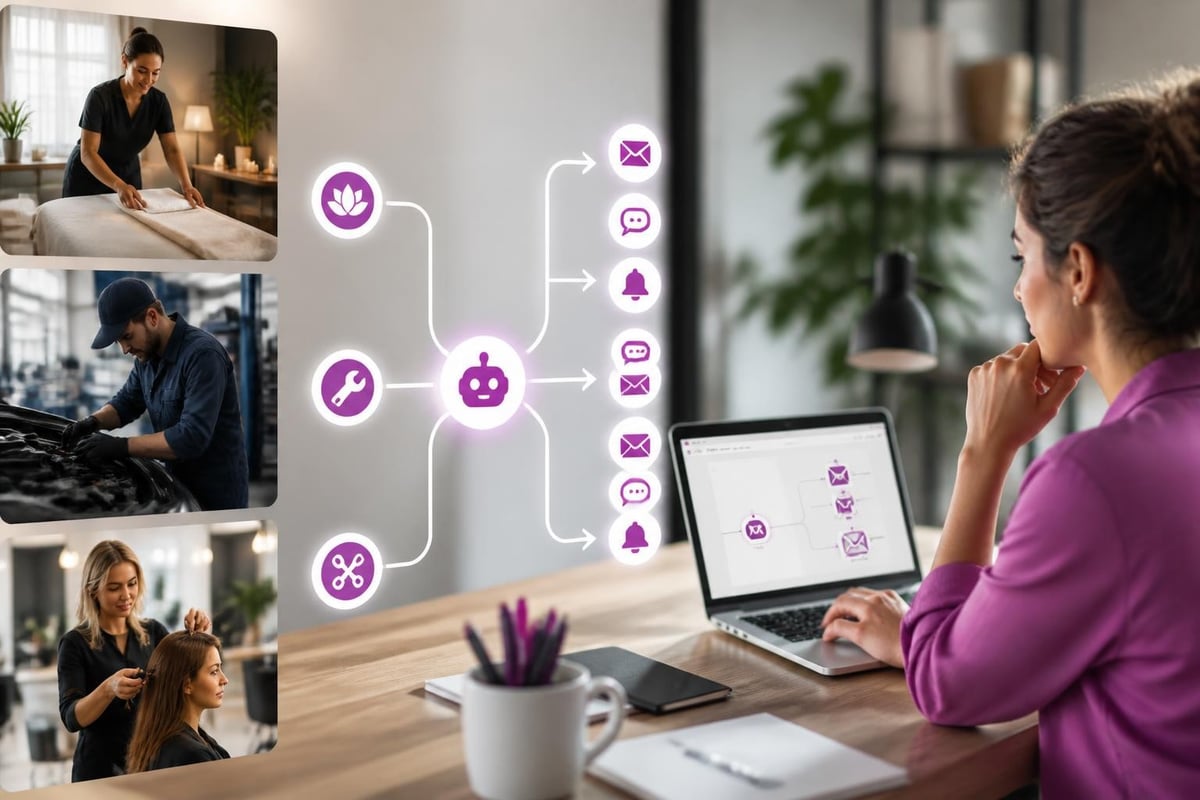
Basic automation is brilliant, but AI can make scheduling and customer follow-up genuinely intelligent. Custom AI agents can handle tasks that traditional automation can't touch:
- Natural language booking – customers text or message in plain English, and AI extracts the details and books it
- Smart rescheduling – AI suggests alternative times based on both calendars when someone can't make it
- Personalised follow-up – messages adapt based on customer history, preferences, and previous interactions
- Predictive no-show alerts – AI spots patterns (weather, time of day, customer behaviour) and flags high-risk bookings
A tradesperson we worked with implemented an AI assistant that handles booking via WhatsApp. Customers just say "Can you come Tuesday afternoon?" and the system handles the rest. His no-show rate dropped by 60%, and he got back three hours a week.
Integration Is Everything
The real magic happens when your scheduling connects to everything else. Your AI system should:
- Update your main calendar automatically
- Sync with your CRM or customer database
- Trigger job preparation workflows
- Update inventory or resource allocation
- Feed into your financial tracking
This level of integration used to require expensive custom development. Now, with modern AI tools and platforms, it's achievable for businesses of any size. Our AI technology services focus on exactly this kind of practical implementation.
Making It Happen Without the Headaches
Here's the thing about implementing better scheduling and customer follow-up: you don't need to do everything at once. Start small and build.
Week 1: Set up a proper online booking system. Even if it only handles 20% of your bookings initially, that's time saved.
Week 2: Add automated confirmation and reminder messages. Use templates at first; you can personalise later.
Week 3: Implement post-service follow-up. One simple message makes a massive difference.
Month 2: Start building re-engagement sequences for your different customer types.
Month 3: Look at AI enhancements based on what's still taking time or where customers are getting stuck.

Common Mistakes to Avoid
- Over-complicating it – your customers want easy, not fancy
- Forgetting to test – book an appointment yourself and see what the experience is actually like
- Ignoring the data – track no-show rates, response rates, and booking sources to see what's working
- Being too automated – some situations need a human touch; make sure there's always an easy way to reach you
For sectors like retail or professional services, the balance between automation and personal service is crucial. You want efficiency without losing the human connection that makes customers choose you in the first place.
Measuring What Matters
How do you know if your new scheduling and customer follow-up systems are actually working? Track these metrics:
| Metric | What It Tells You | Target |
|---|---|---|
| No-show rate | How effective your reminders are | Under 5% |
| Booking-to-confirmation time | System efficiency | Under 2 minutes |
| Self-service vs manual bookings | Adoption rate | 60%+ self-service |
| Follow-up response rate | Message quality | 15-25% |
| Repeat booking rate | Customer retention | Varies by industry |
Don't just set it and forget it. Review these numbers monthly and adjust your approach based on what the data's telling you.
Better scheduling and customer follow-up isn't just about saving time, though that's certainly part of it. It's about creating a professional, reliable experience that makes customers trust you and want to work with you again. The good news? This is exactly the kind of practical, measurable improvement that AI excels at. If you're ready to stop playing phone tag and start building automated systems that actually work for your business, AI 4 Small Business can help you identify the right tools, build the right workflows, and implement solutions that deliver results fast-without the jargon or the massive price tag.