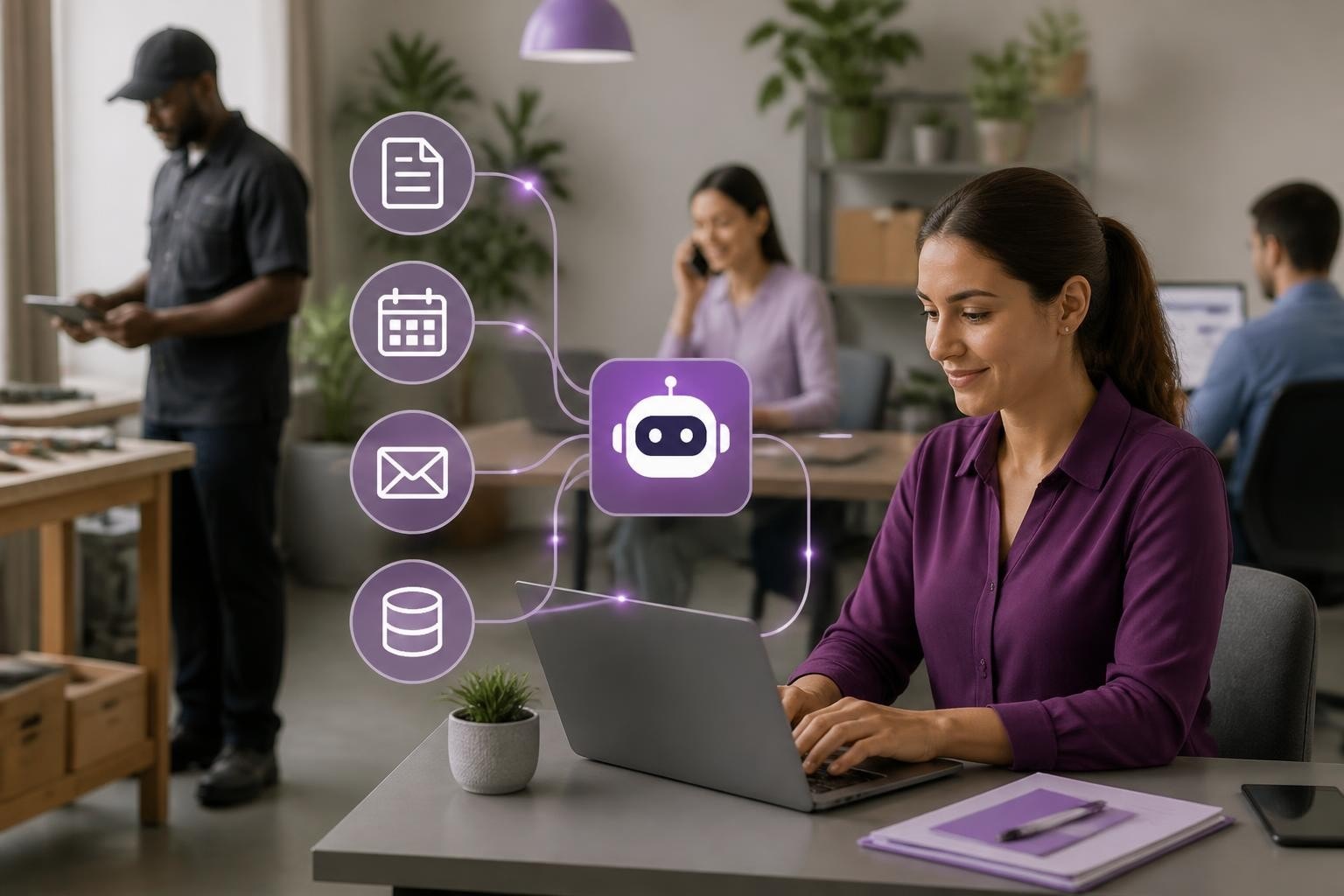
The conversation around ai and the future of work often feels dominated by large corporations and tech giants, but the reality is that small businesses stand to benefit just as much-if not more-from practical AI adoption. Whether you're running a trade business, managing a retail shop, or providing professional services, AI is already changing how work gets done. The key isn't to fear replacement or chase every shiny new tool, but to understand where AI can genuinely solve problems, save time, and help your team focus on what matters most.
What AI and the Future of Work Actually Means for Small Businesses
Let's cut through the noise. When we talk about ai and the future of work, we're really discussing three fundamental shifts:
- Automation of repetitive tasks that drain time and energy
- Enhanced decision-making through better data analysis
- New ways of working that blend human creativity with AI efficiency
PwC's research on AI and workforce transformation highlights how businesses need to reimagine their approach to work, but for small businesses, this doesn't mean wholesale reinvention. It means identifying the bottlenecks-admin tasks, customer queries, scheduling chaos-and applying AI where it delivers measurable impact.
Think about a plumbing business spending hours each week on appointment scheduling, quote follow-ups, and invoicing. An AI assistant for business can handle these tasks automatically, freeing up the owner to focus on quality work and customer relationships.

The Real-World Impact: Beyond the Headlines
You've probably seen headlines about AI replacing jobs. But IBM's analysis of AI's impact on work reveals a more nuanced story: AI increases task productivity while enabling humans to take on more strategic roles. For a small retail business, this might mean using machine learning in retail to predict inventory needs whilst your team focuses on creating brilliant customer experiences.
Here's what we're seeing across different sectors:
| Sector | Traditional Time Drain | AI Solution | Time Saved |
|---|---|---|---|
| Recruitment | Manual CV screening | AI-powered recruiting | 70-80% |
| eCommerce | Customer service queries | AI chatbots | 60-70% |
| Professional Services | Meeting notes & follow-ups | AI transcription & automation | 50-60% |
| Trades | Quote preparation | Automated quote generation | 40-50% |
Implementing AI Without the Overwhelm
The beauty of ai and the future of work is that you don't need a massive budget or technical team to get started. You need clarity about what's broken and a pragmatic approach to fixing it.
Start With Your Biggest Pain Points
Walk through your typical week and ask yourself:
- What tasks make you think "there must be a better way"?
- Where do mistakes happen most often?
- What's stopping you from growing right now?
For many small businesses, the answer involves customer communication. An AI phone assistant can handle initial enquiries, book appointments, and qualify leads-all whilst you're on-site with customers or managing your team.
Build Capability, Not Dependency
This is crucial. The future of work with AI isn't about outsourcing your brain to machines-it's about building systems that enhance what you already do well. Deloitte's exploration of generative AI emphasises augmentation over replacement, and that's exactly the mindset small businesses need.
Think of AI as your business partner who never sleeps, never complains, and excels at the boring stuff. You bring the expertise, relationships, and creative thinking. AI handles the admin.

Sectors Leading the Charge
Different industries are adopting AI at different rates, but the principles remain consistent across sectors.
Retail and eCommerce
Smart retailers are using AI for personalised recommendations, sales automation, and inventory management. A small boutique can now compete with larger chains by offering personalised shopping experiences powered by AI insights.
Recruitment and Professional Services
The recruitment sector has embraced artificial intelligence hiring tools that screen candidates, schedule interviews, and even conduct initial assessments. This allows recruiters to spend more time on the human side of hiring-building relationships and making nuanced judgements.
Logistics and Distribution
From route optimisation to demand forecasting, AI in logistics helps small distribution businesses compete more effectively. Real-time tracking, predictive maintenance, and automated scheduling mean fewer delays and happier customers.
Addressing the Concerns
Let's be honest about the worries. Research shows workers are concerned that AI might expose skill gaps or make their roles redundant. These fears are real, but they're also manageable with the right approach.
The reality:
- AI works best when it complements human skills, not replaces them
- Upskilling your team to work with AI creates more valuable employees
- Small businesses can implement AI gradually, learning as they go
The World Economic Forum's insights suggest that whilst some roles will transform, new opportunities emerge. For small businesses, this often means team members moving from admin-heavy roles to customer-focused or strategic positions.
The Swiss Business Model
Interestingly, businesses working with digital transformation partners like Be Creative in Switzerland are taking a measured, strategic approach to AI adoption-focusing on clear business value rather than technology for its own sake. This practical mindset serves small businesses particularly well.
Making AI Work in 2026
The landscape of ai and the future of work is evolving rapidly, but certain principles remain constant for small businesses:
Focus on outcomes, not technology. Don't implement AI because it's trendy. Implement it because you've identified a specific problem it can solve.
Start small, scale smart. Begin with one workflow or process. Get it working brilliantly. Then expand.
Measure everything. Track time saved, errors reduced, revenue increased. AI should deliver measurable results.

Building Your AI-Enhanced Team
Your team's relationship with AI matters enormously. The most successful small businesses treat AI implementation as a collaborative process, involving employees in decisions about which tools to use and how to deploy them.
Consider creating simple process workflows that map out how AI and humans interact. This clarity helps everyone understand their role and reduces anxiety about change.
Training and Development
Upskilling doesn't require expensive courses. Many AI tools are intuitive enough for team members to learn through hands-on use. The key is creating a culture where experimentation is encouraged and mistakes are seen as learning opportunities.
The Competitive Edge
Here's something many small business owners don't realise: early AI adoption creates a significant competitive advantage. Whilst your competitors are still manually processing orders or responding to emails, you're scaling efficiently and delivering faster service.
This isn't about becoming a tech company. It's about being a better version of whatever business you already run-a more responsive plumber, a more organised retailer, a more efficient recruitment agency.
The businesses thriving with ai and the future of work aren't necessarily the most technical. They're the ones willing to challenge how they've always done things and embrace practical solutions that deliver real results.
The transformation of work through AI is happening now, not in some distant future, and small businesses have everything to gain from thoughtful adoption. If you're ready to explore how AI can solve real problems in your business-without the hype or complexity-AI 4 Small Business specialises in practical, results-driven implementation tailored to your specific needs. We help you identify the right opportunities, choose the right tools, and build automations that deliver measurable impact fast.