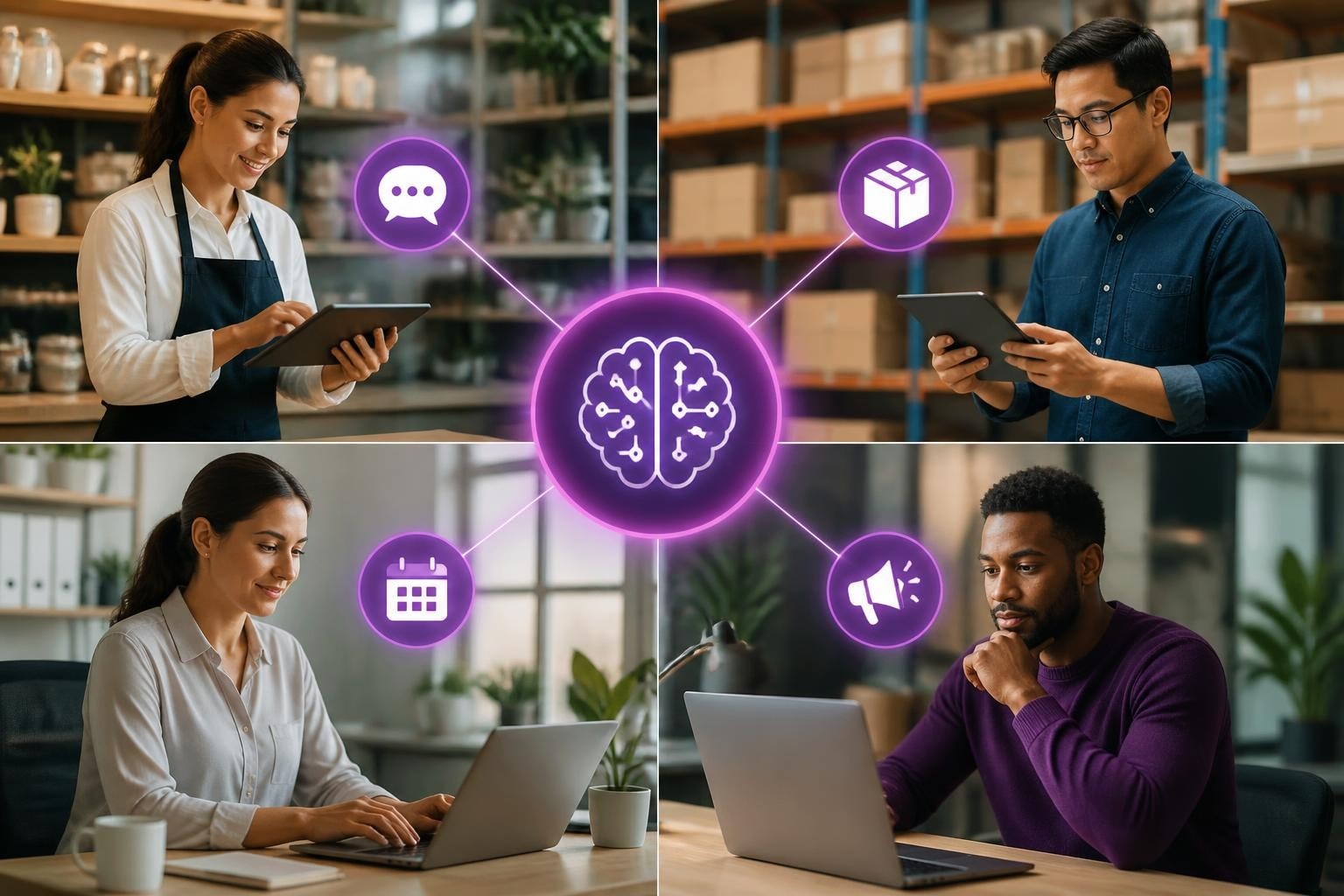
The marketing landscape has shifted dramatically in 2026, and small businesses are facing a dilemma. You need to compete with bigger brands, but you don't have massive budgets or dedicated marketing teams. That's where an ai marketing agency comes in, but not in the way you might think. Forget fancy dashboards that nobody uses or complicated platforms that require a PhD to operate. The real value comes from agencies that focus on implementation, automation, and measurable outcomes that actually move the needle for your business.
What Makes an AI Marketing Agency Different
Traditional marketing agencies sell you campaigns, content calendars, and creative services. An ai marketing agency should be selling you something fundamentally different: systems that work while you sleep.
The difference lies in how AI handles repetitive marketing tasks. We're talking about automated email sequences that personalise themselves based on customer behaviour, content creation workflows that reduce production time by 80%, and ad campaigns that optimise themselves in real-time. Meta's AI advertising tools have shown staggering ROI by tailoring ad formats to individual viewers automatically.
Key Capabilities to Look For
- Workflow automation that connects your existing tools
- Data integration across platforms without manual exports
- Content generation with your brand voice built in
- Performance tracking that actually tells you what's working
- Customer segmentation that happens automatically
The best part? These aren't theoretical benefits. Businesses implementing AI-powered marketing are seeing real results, like Ahrefs' AI agents that compress a 40-hour work week into 60 minutes.
Practical AI Marketing Applications
Let's get specific about what an ai marketing agency actually builds for small businesses.

For Retail and eCommerce
Your online shop generates tonnes of data every day. An AI system can analyse purchase patterns, automatically segment customers, and trigger personalised campaigns based on browsing behaviour. When someone abandons their cart, the system sends a tailored email. When a customer hasn't purchased in 60 days, they get a re-engagement offer.
One florist we worked with automated their entire seasonal campaign process. The AI now schedules promotions, generates product descriptions, and adjusts ad spending based on local events and weather patterns. Similar approaches work brilliantly for AI in retail applications.
For Professional Services
Professional services firms waste hours on proposal creation, client onboarding, and follow-up sequences. AI can draft proposals using your past successful examples, automatically personalise them for each prospect, and track engagement.
A recruitment agency recently implemented an AI-driven recruitment system that screens applications, schedules interviews, and sends follow-up communications. Their time spent on admin dropped by 60%.
For Trades and Construction
Marketing isn't just for B2C businesses. Tradespeople and construction firms benefit enormously from automated quote follow-ups, review requests, and seasonal campaign triggers. AI in construction extends beyond marketing to project management, but the marketing automation alone pays for itself.
Building vs. Buying AI Marketing Solutions
Here's where most small businesses get stuck. You've got three options:
| Approach | Cost | Time to Value | Customisation | Maintenance |
|---|---|---|---|---|
| DIY with Tools | Low | Slow | Limited | High effort |
| Off-the-Shelf Platform | Medium | Medium | Very limited | Low effort |
| Custom AI Agency Build | High upfront, low ongoing | Fast | Fully tailored | Minimal |
The DIY route sounds appealing until you're three months in and still trying to connect your CRM to your email platform. Off-the-shelf solutions work for generic businesses, but they're not built for your specific workflow.
An ai marketing agency worth working with will audit your current processes, identify bottlenecks, and build automation that fits how you actually work. Google's Pomelli AI aims to assist small businesses with campaign creation, but it's still a generic tool that requires configuration.
What Implementation Actually Looks Like
Let's walk through a real example. A professional services firm came to us spending 15 hours weekly on marketing tasks:
- Week 1-2: We mapped their entire marketing process, from lead capture to client onboarding
- Week 3-4: Built automated workflows connecting their website forms, CRM, and email platform
- Week 5-6: Created AI-powered content templates for proposals, follow-ups, and newsletters
- Week 7-8: Implemented tracking and optimisation systems

By week eight, they were spending 3 hours weekly on marketing oversight instead of 15 hours on execution. The system handles lead nurturing, proposal generation, and client communication automatically.
Measuring What Matters
An ai marketing agency should obsess over metrics that affect your bottom line, not vanity metrics. Forget follower counts and impressions. Focus on:
- Time saved on repetitive tasks
- Conversion rate improvements from personalisation
- Revenue per lead from better nurturing
- Customer lifetime value increases from retention automation
- Cost per acquisition reductions from optimised campaigns
Our sales automation AI approaches prioritise these outcome-focused metrics over activity-based ones.
The Hidden Benefits Beyond Marketing
Here's something most businesses don't realise until they're six months into AI marketing automation: the benefits spill over into other areas.
The customer data you're collecting for marketing helps with inventory planning. The content generation systems work for internal communications too. The workflow automation skills transfer to operations and admin processes.
One retail client started with marketing automation, then expanded into AI-powered workflow applications across their entire business. Their operational efficiency improved by 40% within a year.

Avoiding Common Pitfalls
Not all AI marketing implementations succeed. Here's what typically goes wrong:
Trying to automate everything at once. Start with one high-impact workflow, prove the value, then expand. We typically begin with email nurturing or content creation because the ROI is immediate and obvious.
Ignoring data quality. AI is only as good as the data you feed it. If your CRM is full of duplicate contacts and outdated information, no AI system will fix that. Clean your data first.
Expecting magic without input. AI amplifies your marketing strategy; it doesn't create one from nothing. You still need to understand your customers and value proposition. The AI just helps you execute at scale.
Choosing tools before defining processes. Too many businesses buy AI platforms and then try to fit their processes around the tool. Define what you need first, then find the right solution.
Finding the Right AI Marketing Partner
The ai marketing agency landscape is crowded with providers promising the moon. Here's how to separate the practical from the hype:
Look for agencies that ask about your processes before they talk about tools. They should want to understand your bottlenecks, not sell you a pre-packaged solution. Check if they've worked in your sector. AI solutions for different business types vary significantly.
Ask for specific examples of time saved and revenue generated, not just client lists. Request a process audit before any proposal. If they can't clearly explain what they'll automate and how it'll save you time, walk away.
The 2026 Reality
We're past the experimental phase of AI in marketing. The tools work, the integrations exist, and the ROI is proven. The question isn't whether to implement AI marketing automation but how quickly you can get started.
Small businesses that embrace practical AI implementation now will have a significant competitive advantage over those still doing everything manually. The gap will only widen as AI capabilities improve throughout 2026 and beyond.
The key is finding an ai marketing agency that focuses on implementation over promises, outcomes over features, and building capability within your business rather than creating dependency on their services.
AI marketing automation isn't about replacing your marketing instincts with algorithms. It's about freeing up your time to focus on strategy and creativity while AI handles the repetitive execution. If you're ready to implement practical, results-driven AI solutions that actually work within your business, AI 4 Small Business specialises in helping small businesses across retail, trades, eCommerce, and professional services build AI systems that deliver measurable impact fast. We'll identify your time-consuming processes, select the right tools, and create automations that save you hours every week.