
Recruitment's always been a proper headache for small businesses, hasn't it? You're already stretched thin, and now you've got to sift through hundreds of CVs, schedule interviews around everyone's diary, and somehow spot the right person who'll actually stick around. The traditional approach to hiring eats time, costs money, and often leaves you wondering if you've missed brilliant candidates simply because their CV didn't use the exact keywords you were looking for. That's where thinking like an ai recruitment company can transform your approach-not by handing everything over to algorithms, but by using smart tools to handle the heavy lifting whilst you focus on the human bits that actually matter.
What An AI Recruitment Company Actually Does
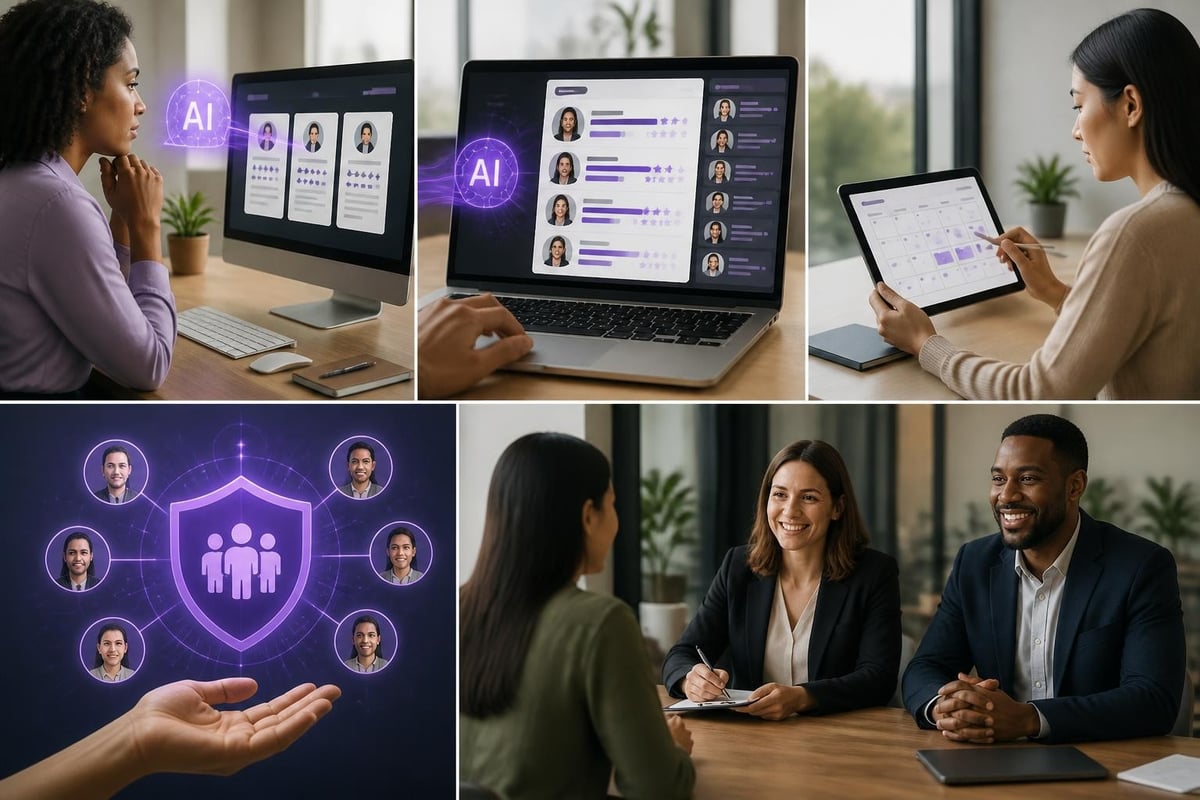
An ai recruitment company uses machine learning and automation to streamline the hiring process from start to finish. But here's the thing: you don't need to become a specialist recruitment firm to benefit from these approaches.
The core functions typically include:
- CV screening and parsing that pulls out relevant skills, experience and qualifications automatically
- Candidate matching using algorithms that compare job requirements against applicant profiles
- Interview scheduling that coordinates calendars without the endless email tennis
- Initial assessment through chatbots that answer candidate questions and gather basic information
- Bias reduction tools designed to make shortlisting fairer by focusing on skills rather than demographics
What's brilliant about the ai recruitment company model is that it doesn't replace human judgment-it enhances it. According to systematic research on AI's role in employee recruitment, these tools are most effective when they handle repetitive admin tasks whilst humans make the final hiring decisions.
Breaking Down the Technology
You don't need a computer science degree to understand what's happening under the bonnet. Most recruitment AI uses natural language processing (NLP) to read CVs and job descriptions, then scores candidates based on how well they match. Some platforms add in predictive analytics that estimate things like retention likelihood or team fit.
The World Economic Forum highlights that transparency in these systems matters enormously-candidates deserve to know when AI is involved in evaluating them, and you need to understand how the technology makes its recommendations.
Practical Tools Small Businesses Can Use Today
Right, let's talk specifics. You don't need enterprise-level budgets to benefit from AI recruitment approaches. Here are tools that actually work for small teams:
| Tool Type | What It Does | Best For |
|---|---|---|
| Applicant Tracking Systems (ATS) with AI | Organises applications, scores CVs, sends automated updates | Businesses hiring regularly |
| Interview scheduling platforms | Coordinates calendars, sends reminders, reschedules automatically | Any hiring process |
| Skills assessment tools | Tests technical abilities, soft skills, or role-specific knowledge | Roles requiring specific competencies |
| Chatbot pre-screeners | Answers FAQs, collects basic info, filters out clearly unsuitable candidates | High-volume hiring |
Many of these platforms offer free tiers or affordable monthly subscriptions. The key is picking tools that solve your actual bottleneck-if you're drowning in CVs, prioritise screening automation. If scheduling's your nightmare, start there.
Similar to how custom AI agents can be tailored for specific business workflows, recruitment tools work best when configured to match your hiring process, not the other way around.
The Fairness Question You Can't Ignore
Here's where it gets serious: AI can absolutely perpetuate bias if you're not careful. Research published in Nature shows that candidates are highly sensitive to how algorithmic systems treat them, and unfair AI hiring can damage your employer brand permanently.
Common bias risks include:
- Training data reflecting historical discrimination (if your past hires were predominantly one demographic, the AI learns that pattern)
- Keyword matching that disadvantages candidates who describe skills differently
- Proxy discrimination where seemingly neutral factors (like postcode or university) correlate with protected characteristics
- Lack of transparency making it impossible for candidates to understand or challenge decisions
The ACLU has extensively documented how digital hiring tools can amplify existing inequalities if implemented without proper safeguards.
Building Fairer Systems
The good news? You can mitigate these risks with some straightforward practices:
- Audit your training data - If you're using a tool that learns from your past hires, check those hires for diversity gaps first
- Use multiple assessment methods - Don't rely solely on CV screening; combine AI scoring with skills tests and structured interviews
- Regularly review outcomes - Track who makes it through each stage by demographic groups to spot patterns
- Keep humans in the loop - Always have a person review AI recommendations before making offers
- Follow established frameworks - NIST's AI Risk Management Framework provides practical guidance for trustworthy AI systems including hiring applications

Setting Up Your First AI Recruitment Workflow
Let's make this practical. Here's how a small business might implement AI recruitment without a massive project:
Week 1: Map your current process Document every step from posting a job to making an offer. Identify where you're losing the most time-that's where AI delivers the quickest wins.
Week 2: Choose one tool Don't try to automate everything at once. Pick the biggest pain point and find one affordable tool that addresses it. Most offer free trials.
Week 3: Configure and test Set up the tool using a recent job posting. Run a few test candidates through (real past applications work well) to see how it performs.
Week 4: Go live with oversight Use the tool on a real vacancy, but check every recommendation manually. This helps you build trust in the system and spot any issues early.
This measured approach, similar to strategies outlined in understanding AI automation ROI, ensures you're getting genuine value rather than adopting technology for technology's sake.
The Candidate Experience Angle
Here's something often overlooked: IEEE research on applicant perceptions shows that how candidates experience AI recruitment directly affects whether they accept offers and recommend your business to others.
Fast, transparent, respectful processes create positive impressions. Automated rejection emails with zero feedback? Not so much.
Candidates appreciate AI when it:
- Speeds up the process (nobody likes waiting weeks for a response)
- Provides clear communication at each stage
- Offers the option to speak with a human when needed
- Explains how and why they were assessed
They dislike it when it feels impersonal, opaque, or like they're being judged unfairly by a black box.
Think about process automation more broadly-the best implementations enhance human interactions rather than replacing them entirely.
What Small Recruitment Agencies Are Actually Doing
Smaller ai recruitment company operators are focusing on niche markets where they can add genuine value through specialisation. Rather than competing with massive job boards, they're using AI to:
- Build talent pools in specific industries or skill areas, maintaining relationships with candidates over time
- Provide faster turnaround for clients by automating the initial screening stages
- Offer better matching by understanding nuanced role requirements that generic platforms miss
- Reduce admin burden so consultants spend more time on relationship building
For professional services firms, construction businesses, or specialist trades looking to hire regularly, adopting some of these practices internally makes sense. The SHRM guidance on AI's impact in talent acquisition provides excellent frameworks for HR practitioners thinking about this transition.

Real-World Implementation Challenges
Let's be honest about what doesn't work. You'll hit obstacles, and that's normal.
Common problems and solutions:
| Challenge | Why It Happens | Practical Fix |
|---|---|---|
| Tool doesn't match your needs | Chose based on features, not actual workflow | Map your process first, then find tools that fit |
| Staff resistance | Fear of being replaced or distrust of technology | Involve team early, emphasise AI handles admin so they can focus on judgment |
| Poor candidate quality | System optimised for speed over fit | Adjust scoring criteria, add human review stage |
| Integration headaches | New tool doesn't talk to existing systems | Choose platforms with open APIs or use integration tools like Zapier |
| Hidden costs | Free tier limits hit quickly | Budget for realistic usage from the start |
The key insight? Start small, measure everything, and scale what works. This principle applies whether you're exploring AI-based recruiting or any other business automation.
Getting Started Without the Overwhelm
You don't need to transform your entire hiring process overnight. Pick one upcoming vacancy and experiment with one AI tool. See if it actually saves time and improves outcomes. If it does, expand gradually. If it doesn't, try something different.
The beauty of modern AI recruitment approaches is that most tools offer monthly subscriptions you can cancel anytime. There's minimal risk in testing whether an ai recruitment company mindset suits your business.
For context on how AI fits into broader business operations, exploring resources like AI and the future of work helps frame recruitment automation within larger digital transformation conversations.
Adopting an AI recruitment company approach doesn't mean losing the human touch-it means freeing up time to focus on the conversations and assessments that genuinely require human judgment. Whether you're hiring your first employee or your fiftieth, the right tools can make the process faster, fairer, and far less painful. If you're ready to explore how AI can streamline your hiring process with practical, no-nonsense solutions tailored to your business, AI 4 Small Business can help you identify the right tools and implement them effectively-no hype, just results that work.