
You've probably noticed AI popping up everywhere lately-chatbots answering customer queries, email assistants drafting responses, scheduling tools managing appointments. But when did this all begin? Understanding when ai started and how it evolved helps small business owners cut through the hype and see AI for what it really is: a set of practical tools that have been decades in the making. This isn't some overnight sensation-it's technology that's matured to the point where even the smallest businesses can benefit without needing a computer science degree or massive budgets.
The Early Days: When AI Started as a Concept
The term "artificial intelligence" was coined in 1956 at a conference at Dartmouth College. That's when ai started as an official field of study, though the ideas behind it go back further. Researchers like Alan Turing had already been asking whether machines could think, laying groundwork in the 1940s and 50s.
These early pioneers weren't building chatbots or automating invoices. They were wrestling with fundamental questions: Could machines solve problems? Could they learn? The historical development tracked by medical researchers shows how AI evolved from theoretical computing into something tangible.
From Theory to Practice
The gap between theory and practice was massive. Early AI systems could play chess or solve mathematical proofs, but they couldn't handle messy, real-world business problems. Progress was slow, funding dried up during "AI winters," and practical applications seemed decades away.
Key milestones that mattered:
- Expert systems in the 1980s (rule-based decision support)
- Machine learning breakthroughs in the 1990s
- Statistical models that could actually predict patterns
- Deep learning advances in the 2010s
Each wave brought AI closer to solving everyday business problems rather than just academic puzzles.
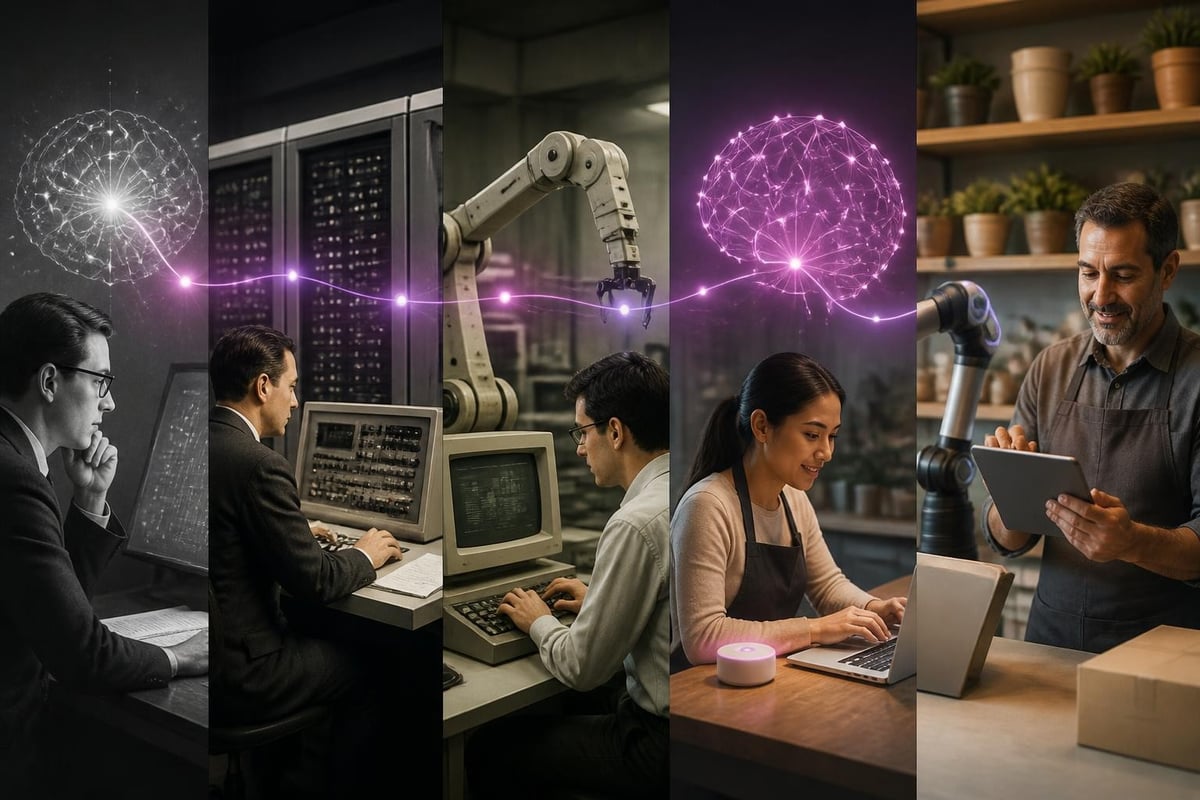
The Transformer Moment: When AI Started Getting Useful
In 2017, something significant happened. Google researchers published a paper introducing the Transformer architecture, which became the foundation for modern large language models. This wasn't just another incremental improvement-it was the breakthrough that made AI genuinely useful for language tasks.
Suddenly, AI could understand context, generate human-like text, and handle the kind of messy communication that happens in real businesses. This is when ai started becoming practical for tasks like customer service, content creation, and data analysis.
| Before Transformers | After Transformers |
|---|---|
| Limited context understanding | Grasps nuance and intent |
| Rigid, template-based responses | Natural, conversational output |
| Required extensive programming | Can be guided with plain English |
| Domain-specific only | General-purpose capability |
The difference for small businesses? You no longer needed custom development for every task. Tools built on this technology could handle everything from automating customer follow-ups to drafting proposals.
AI in 2026: Where We Are Now
Fast forward to today, and AI tools are everywhere. According to Stanford's AI Index 2024, adoption has accelerated dramatically across industries of all sizes.
What's Actually Working for Small Businesses
Forget the hype about AI replacing everything. Here's what's genuinely delivering results:
Customer-facing automation:
- Chatbots handling common questions 24/7
- Email assistants managing inbox overflow
- Appointment scheduling without the back-and-forth
- Review responses that maintain your brand voice
Back-office efficiency:
- Invoice processing and data entry
- Report generation from raw data
- Meeting transcription and summaries
- Document classification and filing
Marketing and sales:
- Content drafting (blogs, social posts, product descriptions)
- Ad copy testing and optimization
- Lead scoring and follow-up prioritization
- Personalized email campaigns
The shift isn't just about capability-it's about accessibility. Custom AI agents for small business are now affordable and practical, not sci-fi.

The Implementation Gap: Knowing vs. Doing
Here's the thing: knowing when ai started or understanding what's possible doesn't automatically translate to results. Most small businesses face a gap between awareness and implementation.
Common Roadblocks
- Tool overwhelm - There are thousands of AI tools. Which ones actually matter?
- Integration challenges - How does this fit with existing systems?
- Skills gap - Who sets this up and maintains it?
- ROI uncertainty - Will this actually save time and money?
Research on managing AI risks effectively highlights the importance of thoughtful implementation, not just adoption for its own sake.
A Practical Approach
The businesses getting value from AI aren't the ones with the biggest budgets or the most technical staff. They're the ones taking a systematic approach:
- Identify specific pain points - What's eating up time right now?
- Start small - Automate one process, measure impact
- Build on success - Expand what works, ditch what doesn't
- Focus on integration - AI should fit your workflow, not vice versa
This is exactly why understanding whether you can DIY AI matters. Sometimes you can. Sometimes you need guidance.
Different Sectors, Different Applications
AI doesn't look the same across every business type. A plumber's needs differ wildly from a boutique retailer's.
| Sector | High-Impact AI Use | Example Outcome |
|---|---|---|
| Trades | Automated quoting and scheduling | 5-8 hours saved per week |
| Retail | Inventory prediction and customer service | Reduced stockouts, faster responses |
| Professional Services | Document analysis and client communication | More billable hours, less admin |
| eCommerce | Product descriptions and customer support | Better conversion, 24/7 availability |
The pattern? AI works best when it tackles repetitive, time-consuming tasks that follow patterns. That frees you up for the work that actually requires human judgment and creativity.

Looking Forward: What Actually Matters
We're at an interesting point. When ai started, it was all potential. Now it's all execution.
The businesses that'll benefit most in 2026 and beyond aren't waiting for the "perfect" AI solution. They're identifying processes that waste time, testing practical tools, and measuring results. They're treating AI as a means to an end-better service, lower costs, faster growth-not as an end in itself.
The key questions to ask:
- Where do bottlenecks slow us down?
- What tasks are we doing manually that follow patterns?
- Which customer interactions could be faster or more consistent?
- What data are we collecting but not using?
The answers point toward AI-powered workflows that genuinely improve how you work.
Why Expert Guidance Accelerates Results
You can absolutely learn this stuff yourself. Many business owners do. But there's a real cost to the learning curve-time spent researching tools, testing integrations, and troubleshooting issues.
Working with specialists who focus on real-world AI implementation means you skip the trial-and-error phase. You get tools selected for your specific needs, integrated properly, and delivering measurable impact faster.
It's not about building dependency-it's about building capability. The right approach leaves you with systems you understand and can manage, not black boxes you're afraid to touch.
Understanding when ai started helps, but what matters now is how you apply it. AI has evolved from academic theory to practical tools that small businesses use every day to save time, reduce admin, and serve customers better. If you're ready to move from awareness to action, AI 4 Small Business helps you identify the right opportunities, implement the right tools, and deliver measurable results without the hype or complexity. Let's focus on what actually works for your business.