
You've invested time, money, and resources into AI. You've followed the hype, watched the demos, and believed the promises. Yet here you are, facing the frustrating reality of ai not working as advertised. You're not alone. Most small businesses encounter significant obstacles when implementing AI, but the problem isn't the technology itself. The real issue lies in how we approach, understand, and deploy these powerful tools.
Beyond the ChatGPT Illusion
When most people think about AI, they immediately picture ChatGPT or similar chatbots. This narrow view is precisely why so many AI initiatives stumble.
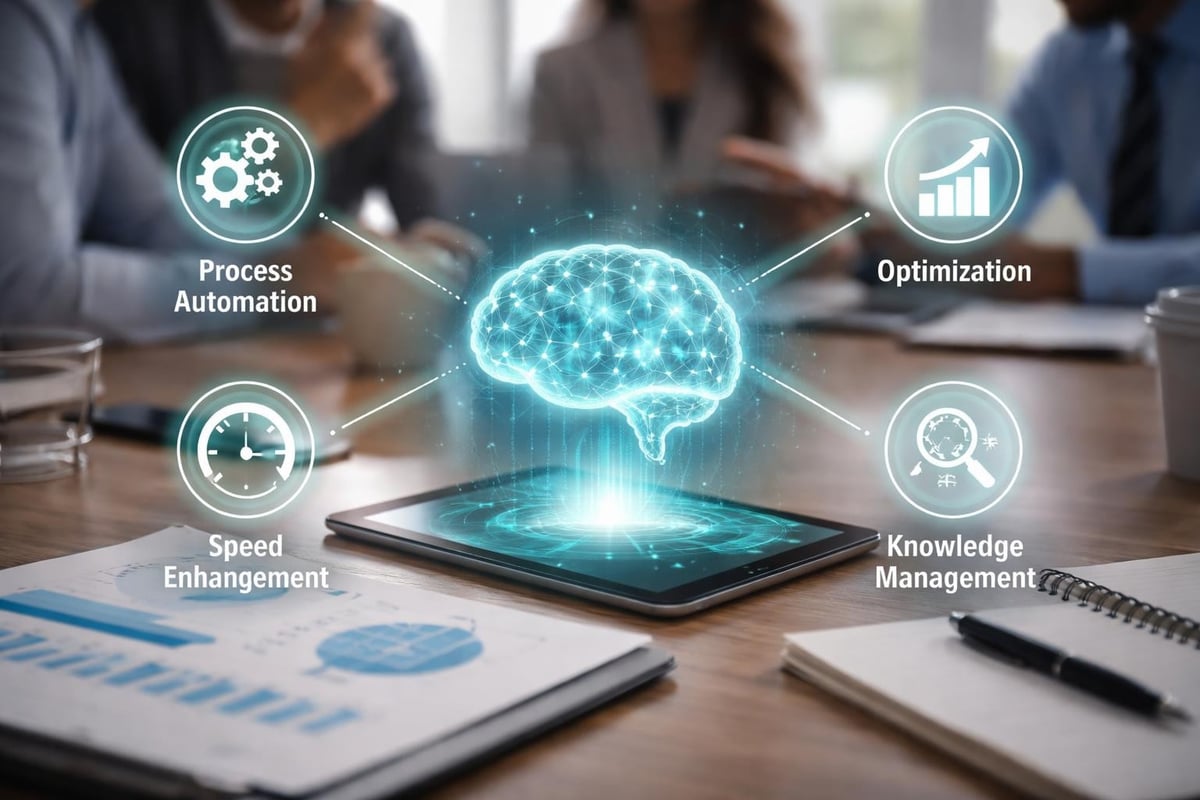
AI is fundamentally about three core capabilities:
- Decision automation – enabling systems to make consistent, data-driven choices
- Process optimization – streamlining workflows and eliminating bottlenecks
- Speed enhancement – accelerating delivery times across your operations
The chatbot represents just one tiny corner of what AI can achieve. Real business transformation happens when you leverage AI to handle repetitive decisions, automate knowledge work, and compress timelines from days to minutes. Using AI for business means understanding these broader capabilities, not just deploying a conversational interface.
The Foundation Problem
Here's the uncomfortable truth: ai not working is rarely about the AI itself. According to research on why AI projects fail, the root causes stem from organisational readiness, not technical limitations.
Before implementing any AI solution, you must have clarity on three fundamental areas:
| Foundation Area | What You Need | Why It Matters |
|---|---|---|
| Processes | Documented, repeatable workflows | AI can't optimise chaos |
| Knowledge | Structured, accessible information | AI requires quality inputs |
| Data | Clean, organised datasets | Garbage in, garbage out |
Too many businesses rush to implement AI without establishing these foundations. They expect the technology to magically organise their messy processes or work with incomplete data. This approach guarantees failure.
Understanding Your Processes First
You cannot automate what you don't understand. This principle seems obvious, yet it's the most commonly violated rule in AI implementation.
Start by mapping your current workflows. Document each step, identify decision points, and note where knowledge transfer happens. Where do tasks get stuck? Which processes rely on tribal knowledge? What decisions require expert judgment?
The LeanAI method provides a structured framework for planning AI implementations by distinguishing between what AI should solve, what it can solve, and what it will actually solve in your specific context.
Consider a small retail business struggling with inventory management. The problem isn't that AI isn't available. The issue is whether they've documented their ordering process, identified seasonal patterns, and structured their historical sales data. Without these foundations, even the most sophisticated AI-powered solutions will flounder.
The Knowledge Gap
Your business holds tremendous institutional knowledge, but is it accessible? Is it documented? Can an AI system actually use it?
Common knowledge management failures:
- Critical information exists only in employees' heads
- Documentation is scattered across multiple platforms
- Processes have evolved but records haven't been updated
- Decision criteria remain unwritten and inconsistent
This scattered approach to knowledge management directly causes ai not working effectively. AI systems need structured, consistent information to generate reliable outputs. The AI trust paradox highlights how even advanced models struggle when the foundational information they access is incomplete or inconsistent.

Data Quality Determines Success
You've heard "garbage in, garbage out" before, but let's be specific about what quality data actually means for AI implementations.
Quality data characteristics:
- Completeness – all relevant fields populated consistently
- Accuracy – information reflects current reality
- Consistency – formats and standards maintained across systems
- Accessibility – data can be retrieved and integrated efficiently
- Timeliness – information is current and updated regularly
A manufacturing business might believe their production data is "fine," but upon examination, they discover missing timestamps, inconsistent product codes, and manual entries that haven't been validated. When they attempt to implement predictive maintenance AI, the system produces unreliable results. The problem isn't the AI algorithm. It's the data foundation.
Understanding costs of AI means accounting not just for the technology itself, but for the data preparation work required beforehand.
The Human-AI Interaction Challenge
Even with solid foundations, ai not working often traces back to how humans interact with these systems. Research on human-AI interaction loop failures reveals that inconsistent human judgments and heuristic biases create suboptimal outcomes.
Your team needs training not just in using AI tools, but in understanding their limitations, interpreting outputs critically, and providing feedback that improves system performance. This isn't a one-time training session. It's an ongoing process of learning and adaptation.
Security and Integration Readiness
The shift from simple AI tools to agent-based AI architectures brings new security considerations. Your existing access controls, data governance policies, and compliance frameworks must extend to AI systems.
According to The Rapidops analysis, business infrastructure gaps and lack of integration readiness rank among the top reasons for AI project failures. You can't bolt AI onto broken systems and expect transformative results.
Implementation Strategy That Works
Successful AI adoption follows a deliberate path, not a rushed deployment schedule.
Phase 1: Assessment
Map your processes, audit your knowledge management, and evaluate your data quality. Identify specific pain points where AI could deliver measurable improvements.
Phase 2: Pilot
Start small with a contained project that addresses a clear business need. Measure results rigorously. Learn what works in your specific context.
Phase 3: Scale
Based on pilot learnings, expand to additional use cases. Build internal expertise. Develop processes for maintaining and improving AI systems.
Phase 4: Optimisation
Continuously refine your AI implementations based on real-world performance and changing business needs.

This measured approach, combined with a four-phase security framework, ensures you're building sustainable AI capabilities rather than creating expensive failures.
Moving from Failure to Success
The difference between ai not working and AI delivering genuine value lies in your preparation and approach. Technology alone solves nothing. Understanding your business, documenting your processes, organising your knowledge, and cleaning your data creates the foundation for AI success.
Stop chasing the latest AI trend. Start building the organisational capabilities that make AI effective. Focus on AI as a tool that enhances human capabilities rather than a magic solution that works independently.
The businesses succeeding with AI aren't necessarily the ones with the biggest budgets or most sophisticated tools. They're the ones who've done the foundational work, who understand their processes deeply, and who approach AI implementation with realistic expectations and solid planning.
Getting AI working requires more than just purchasing the latest tool. It demands understanding your processes, organising your knowledge, and preparing your data infrastructure. When you build these foundations properly, AI transforms from a frustrating expense into a genuine competitive advantage. AI 4 Small Business specialises in helping small businesses navigate this journey with practical, sector-specific solutions that enhance your capabilities without creating dependency. Ready to move beyond ai not working and towards AI that delivers real results? Let's start with understanding what you actually need.


