
Managing orders can be one of the most time-consuming parts of running a small business. Whether you're handling ten orders a week or a hundred, the process of capturing details, updating stock, coordinating deliveries, and keeping customers informed eats up valuable hours. That's where AI order management comes in. It's not about replacing your entire system overnight-it's about identifying the repetitive, error-prone bits and letting intelligent automation handle them whilst you focus on growing your business.
What AI Order Management Actually Does
Let's cut through the jargon. AI order management means using smart software to automate and improve how you process orders from start to finish. Instead of manually copying details from emails, checking stock levels, updating spreadsheets, and sending confirmation messages, AI tools can handle these tasks automatically.
The real magic happens when these systems learn from your data. They can predict when you'll run low on popular items, spot unusual orders that might need your attention, and even suggest the best delivery routes. For a small business, this means fewer mistakes, faster processing, and more time to actually run your company.

Practical Tools You Can Start Using Today
You don't need a massive budget or a tech team to benefit from AI order management. Here are some tools that work for small businesses:
Customer Communication Tools
OrderSnap monitors your emails and messages to make sure no order gets missed. It extracts order details automatically and organises everything in one place. Perfect for trades businesses that take orders via WhatsApp or email.
Procurement Automation
Order.co's AI suite helps businesses automate their purchasing decisions. It analyses your ordering patterns and helps you make smarter procurement choices without the manual legwork.
Workflow Automation
Zapier's AI order management features let you connect your existing tools and trigger actions based on order data. When an order comes in, it can automatically update your CRM, send notifications, and sync with your logistics system.
How Different Sectors Use AI Order Management
| Sector | Common Challenge | AI Solution |
|---|---|---|
| Retail | Managing stock across multiple channels | Real-time inventory sync and reorder alerts |
| Trades | Capturing orders from calls and messages | Voice-to-text order capture and automated quotes |
| eCommerce | High volume order processing | Automated order routing and fulfillment prioritisation |
| Hospitality | Coordinating supplier deliveries | Predictive ordering based on seasonal patterns |
Building Your AI Order Management System
You don't need to implement everything at once. Start with the biggest pain point in your current process.
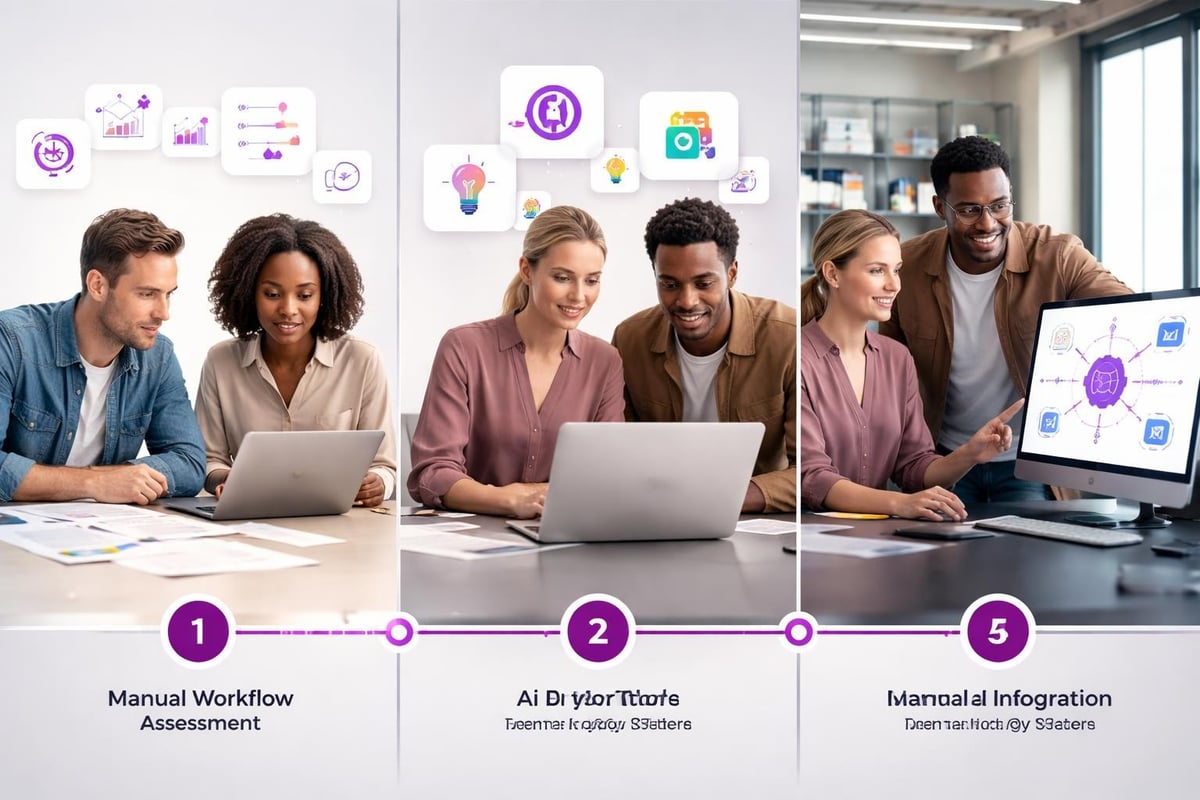
Step 1: Map Your Current Workflow
Write down every step from when an order comes in to when it's completed. Where do you spend the most time? Where do mistakes happen? These are your automation opportunities.
Step 2: Choose Your First Automation
Pick one repetitive task. For most small businesses, this is either order capture (getting details from customers) or order confirmation (sending updates). Tools like AI-powered order management platforms can automate the entire order lifecycle, but starting small gives you quick wins.
Step 3: Connect Your Existing Tools
Your current systems probably work fine-they just need to talk to each other. AI automation can bridge the gap between your email, accounting software, and inventory system without requiring you to replace everything.
The beauty of intelligent supply chain systems is that they adapt to your business processes, not the other way around.
Real-World Implementation Examples
A small electrical supplies distributor we worked with was drowning in order emails. They were manually typing each order into their system, checking stock, and then emailing suppliers. We built a simple AI workflow that reads incoming orders, checks their database, and automatically creates purchase orders when stock is low. They're now processing three times the volume with the same team.
A recruitment agency struggled with candidate placement orders from clients. Requirements would come through in different formats-emails, calls, messages. We implemented an AI business automation system that captures all these communications, extracts the key requirements, and creates standardised job orders. Their response time dropped from hours to minutes.
Common Mistakes to Avoid
- Trying to automate everything at once – Start with one process, prove it works, then expand
- Ignoring your team – The people doing the work know where the problems are; involve them from day one
- Choosing tools based on features – Pick tools that solve your specific problem, not the ones with the longest feature list
- Forgetting about exceptions – AI handles the routine stuff brilliantly, but you'll always need human judgment for unusual cases
What to Look for in AI Order Management Tools
When you're evaluating tools, focus on outcomes rather than specifications. Here's what actually matters:
Integration capability – Does it work with your current systems? The best AI tools enhance what you already have rather than forcing you to start from scratch.
Learning curve – If your team can't use it within a week, it's probably too complex. Simple tools that solve real problems beat sophisticated platforms that nobody understands.
Scalability – Will it grow with you? You might process fifty orders a week now, but what about when that doubles?
Support and training – This matters more than you'd think. When something goes wrong (and it will), can you get help quickly?
Many businesses benefit from expert guidance when implementing AI in business processes, especially when connecting multiple systems or building custom workflows.

Getting Started Without the Overwhelm
The biggest barrier to adopting AI order management isn't the technology-it's knowing where to start. Here's a practical approach:
- Track your time for one week – Write down how long you spend on order-related tasks
- Calculate the cost – Multiply those hours by what your time is worth
- Identify the quick wins – Which tasks are purely repetitive and follow clear rules?
- Test one tool – Most AI platforms offer free trials; pick one and test it on a small batch of orders
- Measure the difference – Compare time spent before and after
You're looking for tasks where the same actions happen repeatedly. Those are perfect candidates for automation. As IBM's agentic AI for order management demonstrates, even complex decision-making in the order lifecycle can be enhanced with the right AI tools-though smaller businesses benefit most from focused, specific automations rather than enterprise-wide platforms.
Making AI Work for Your Business Model
Different business models need different approaches. If you're primarily B2B, your AI order management might focus on handling complex specifications and coordinating with suppliers. For B2C eCommerce, speed and volume processing matter more.
Professional services firms often overlook order management because they're not shipping physical products. But processing work orders, managing client requirements, and coordinating team resources all follow the same principles. The AI case studies we've built show how diverse businesses can apply similar automation strategies to very different challenges.
The key is matching the tool to your specific workflow. Generic solutions work for generic problems, but most small businesses have unique quirks in how they operate. That's not a weakness-it's often what makes you competitive. Your AI implementation should preserve what works whilst eliminating what doesn't.
AI order management isn't about fancy technology-it's about getting orders processed faster, more accurately, and with less manual effort. Whether you start with a simple email monitoring tool or build a comprehensive automated workflow, the goal is the same: free up your time for the work that actually grows your business. If you're ready to identify which parts of your order process could benefit from intelligent automation, AI 4 Small Business can help you build practical solutions that deliver measurable results without the complexity or cost of enterprise systems.