Running a small business means wearing multiple hats whilst trying to keep costs down and productivity up. You're probably spending hours each week on repetitive tasks like data entry, invoice processing, customer queries, or appointment scheduling. What if those hours could be freed up for activities that actually grow your business? That's where ai business process automation comes in, and it's no longer just for big corporations with massive budgets. Today's AI tools are accessible, affordable, and surprisingly simple to implement for businesses of any size.
What AI Business Process Automation Actually Means
Think of ai business process automation as having a tireless assistant who never takes breaks, never makes mistakes, and works 24/7 without complaint. It's about using AI technology to handle routine business tasks automatically, from sorting emails to processing orders to updating customer records.
Unlike traditional automation that follows rigid "if-this-then-that" rules, AI-powered automation can learn, adapt, and make decisions. This means it can handle variations and exceptions that would normally require human judgment. For instance, whilst a basic automation might struggle with a customer email written in an unusual way, AI can understand the intent and respond appropriately.
The Difference That Matters for Small Businesses
Traditional automation is like a train on fixed tracks. It works brilliantly for identical, repetitive tasks but derails when something unexpected happens. AI automation is more like a skilled driver who can navigate detours, read road signs, and make judgement calls.
This flexibility is crucial for small businesses where every day brings something different. You don't need processes to be identical; you need them to be handled intelligently whatever comes through the door.
Where Small Businesses Can Use AI Automation Right Now
The beauty of modern AI tools for business automation is that you can start small and expand as you see results. Here are practical applications that deliver immediate value:
Customer Service & Communication
- Automatically categorising and routing customer emails to the right team member
- Responding to common questions instantly through chatbots
- Scheduling appointments without the back-and-forth emails
- Following up with customers at the right time
Administrative Tasks
- Extracting data from invoices and receipts automatically
- Updating spreadsheets and databases without manual entry
- Creating reports from your business data
- Managing inventory levels and reorder points
Marketing & Sales
- Personalising email campaigns based on customer behaviour
- Qualifying leads before they reach your sales team
- Scheduling social media content intelligently
- Analysing which marketing efforts actually work

The shift towards data-driven process management means small businesses can now benefit from intelligent automation previously available only to large enterprises.
Getting Started Without Breaking the Bank
You don't need a massive budget or a technical team to implement ai business process automation. The key is starting with one pain point that's costing you significant time or money.
Step 1: Identify Your Biggest Time Drain
Look at your typical week. Which repetitive tasks consume the most hours? Common culprits include:
- Manually entering data from one system to another
- Responding to similar customer questions repeatedly
- Chasing unpaid invoices
- Updating customer information across multiple platforms
- Scheduling and calendar management
Step 2: Choose Appropriate Tools
The market offers numerous affordable AI platforms designed specifically for small businesses. Look for tools that:
- Require minimal setup time
- Offer clear pricing without hidden costs
- Integrate with software you already use
- Provide straightforward support
Many platforms offer free trials, allowing you to test before committing. Start with one tool focused on your primary pain point rather than trying to automate everything at once.
Step 3: Implement Gradually
| Phase | Timeline | Focus | Expected Outcome |
|---|---|---|---|
| Testing | Week 1-2 | Set up with sample data | Understand capabilities |
| Pilot | Week 3-6 | Run alongside existing process | Build confidence |
| Full Launch | Week 7+ | Replace manual process | Realise time savings |
This measured approach, detailed in practical AI automation strategies, reduces risk and allows your team to adapt comfortably.
Real-World Impact for Small Businesses
Consider Sarah, who runs a small online shop selling handmade jewellery. She was spending 10 hours weekly on order processing, customer emails, and inventory updates. After implementing ai business process automation:
- Order confirmations and tracking updates now send automatically
- Common customer questions get instant responses
- Inventory levels update across all sales channels without manual intervention
- She's gained back 8 hours per week to focus on product design
Or take James, who operates a local plumbing business. His AI system now:
Handles booking requests 24/7. Customers can schedule appointments even when his office is closed.
Sends appointment reminders automatically. This reduced no-shows by 40%.
Processes quotes and invoices. What took 30 minutes per job now takes 30 seconds.
These aren't exceptional cases. They're typical results when AI solutions are tailored to specific business needs.

Overcoming Common Concerns
"Won't this be complicated to set up?"
Modern AI tools are designed for non-technical users. Many offer visual interfaces where you simply click and drag to create workflows. You're not writing code; you're essentially describing what you want to happen, similar to how natural language can generate workflows.
"What if the AI makes mistakes?"
Start with supervised automation where you review actions before they're finalised. As you build confidence, gradually increase autonomy. Most systems allow you to set rules about when to ask for human approval.
"Will I become too dependent on technology?"
Good automation enhances your capabilities rather than creating dependency. You maintain control and understanding of your processes. The goal is to handle routine tasks automatically whilst you focus on strategic decisions that require human insight, as outlined in avoiding AI dependency.
Measuring Success and Scaling Up
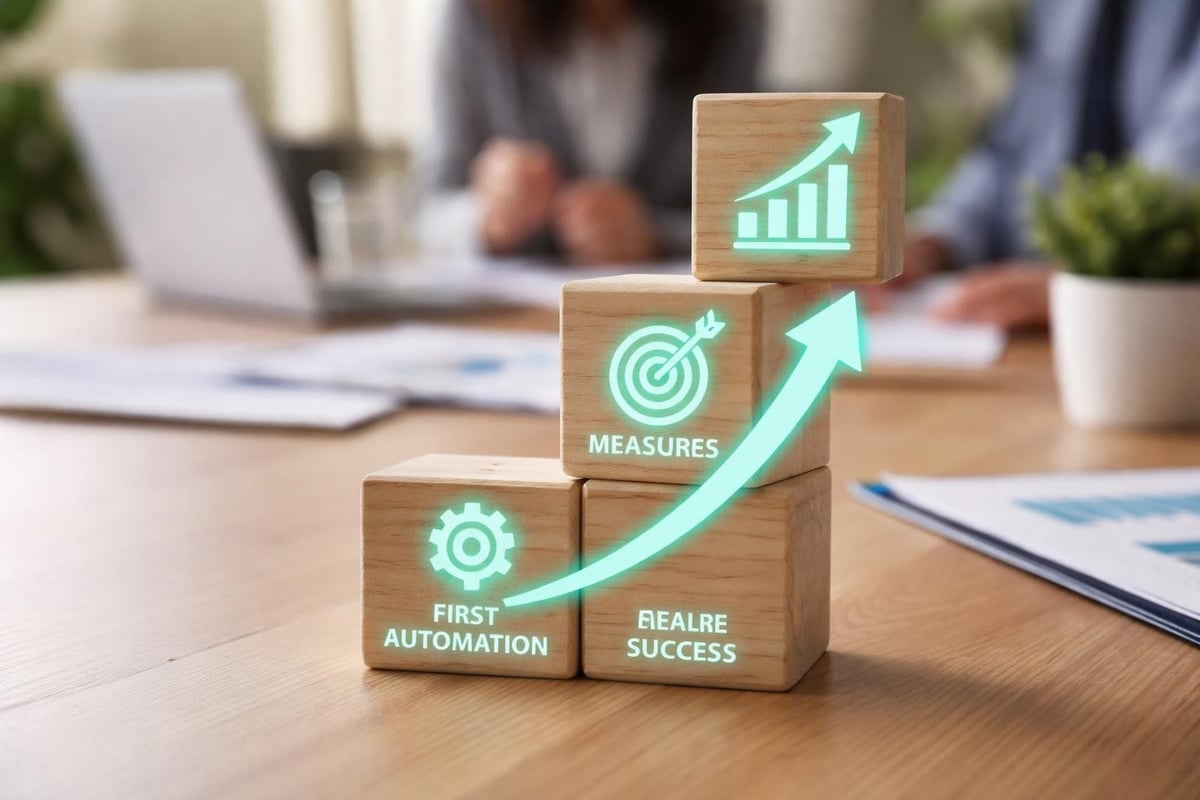
Once your first automation is running smoothly, measuring its impact helps justify expanding to other areas.
Key Metrics to Track
- Time saved: How many hours per week are freed up?
- Error reduction: Are there fewer mistakes in automated tasks?
- Cost savings: What's the financial impact of efficiency gains?
- Customer satisfaction: Are response times faster? Are customers happier?
Track these numbers before and after implementation. The results often surprise business owners with larger-than-expected benefits.
When you're ready to expand, understanding various AI use cases helps identify the next best opportunity. The pattern typically follows:
- Automate the biggest time drain first
- Measure results for 4-6 weeks
- Identify the next priority based on ROI
- Implement with lessons learned from the first automation
- Repeat
Making AI Work for Your Specific Business
Every business is different, which is why sector-specific AI solutions deliver better results than generic tools. A retailer's needs differ vastly from a service provider's, and effective ai business process automation reflects those differences.
For retail businesses, focus on inventory management, order processing, and customer communication automation.
For service businesses, prioritise appointment scheduling, client follow-ups, and project management automation.
For professional services, emphasise document processing, client onboarding, and billing automation.
The comprehensive guide to AI business process automation provides additional context for various business types and their specific automation opportunities.
The Path Forward
AI business process automation isn't about replacing human judgment or creativity. It's about eliminating the tedious, time-consuming tasks that prevent you from focusing on what you do best. Whether that's serving customers, developing products, or growing your business, automation handles the background work efficiently and reliably.
The technology has matured to the point where implementation doesn't require technical expertise or enormous budgets. What it does require is a willingness to identify opportunities, start small, and build confidence through measurable results. For answers to common questions about getting started, practical resources are readily available.
Remember that successful automation isn't about technology alone. It's about understanding your business processes well enough to know which ones benefit from automation and which still require that human touch. The goal is augmentation, not replacement, creating a business that operates more efficiently whilst maintaining the personal service that sets small businesses apart.
AI business process automation offers small businesses the opportunity to compete more effectively by working smarter rather than harder. By starting with high-impact, low-complexity tasks and building from there, you can transform operations without overwhelming your team or budget. If you're ready to explore how automation can specifically benefit your business, AI 4 Small Business provides practical, sector-specific solutions tailored to small business needs and budgets, helping you implement AI tools quickly without creating dependency or breaking the bank.