
You've probably heard "built with AI" thrown around a lot lately. But what does that actually mean for your small business? Beyond the buzzwords and the hype, there's a growing number of practical tools and systems that are genuinely built with AI and making a real difference to how businesses operate. Let's cut through the noise and look at what's actually being created, how it works, and what you can learn from businesses already putting these tools to work.
What Does "Built with AI" Actually Mean?
When something's described as built with AI, it typically means machine learning models are doing the heavy lifting behind the scenes. Instead of following rigid, pre-programmed rules, these systems learn from data and improve over time.
Think about it this way: traditional software follows instructions you give it. AI-powered software learns patterns and makes decisions based on what it's seen before. That's why tools built with AI can handle messy, real-world situations that would trip up conventional systems.
The Practical Difference
Here's where it gets interesting for small businesses:
- Automation that adapts - AI tools don't just repeat the same action; they adjust based on context
- Handling variety - They work with different formats, languages, and edge cases without breaking
- Getting better over time - The more you use them, the more accurate they become
- Understanding intent - They can interpret what customers mean, not just what they say

Real-World Tools Built with AI That Small Businesses Use
Let's get specific. What are businesses actually using that's built with AI? Surprising things built with AI span everything from customer service to creative work, but here are the ones making the biggest impact for small businesses right now.
Customer Communication Tools
AI-powered chatbots and email assistants are probably the most visible examples. These aren't the clunky "press 1 for sales" systems from years ago. Modern tools built with AI understand context, handle complex queries, and sound genuinely human.
What they're doing:
- Answering common questions 24/7 without human input
- Routing complex enquiries to the right team member
- Following up automatically based on customer behaviour
- Drafting personalised responses that your team just needs to review
Many AI business services now include these communication tools as standard, particularly for eCommerce and professional services firms.
Process Automation Systems
This is where things get really practical. Tools built with AI can watch how you work and then replicate those processes. Examples of AI in industry show this happening across manufacturing, logistics, and service businesses.
| Process Area | What AI Does | Business Impact |
|---|---|---|
| Invoice Processing | Extracts data, matches to POs, flags anomalies | 80% faster processing, fewer errors |
| Appointment Scheduling | Handles bookings, reschedules, sends reminders | Eliminates double-bookings, reduces no-shows |
| Quote Generation | Pulls pricing, calculates costs, creates documents | Same-day quotes instead of next-week |
| Inventory Management | Predicts demand, suggests reorders, tracks trends | Less stock-outs, lower holding costs |
How These AI Tools Are Actually Built
You might be wondering: do you need a team of developers to create something built with AI? Not anymore. That's changed dramatically in the past couple of years.
The Development Landscape in 2026
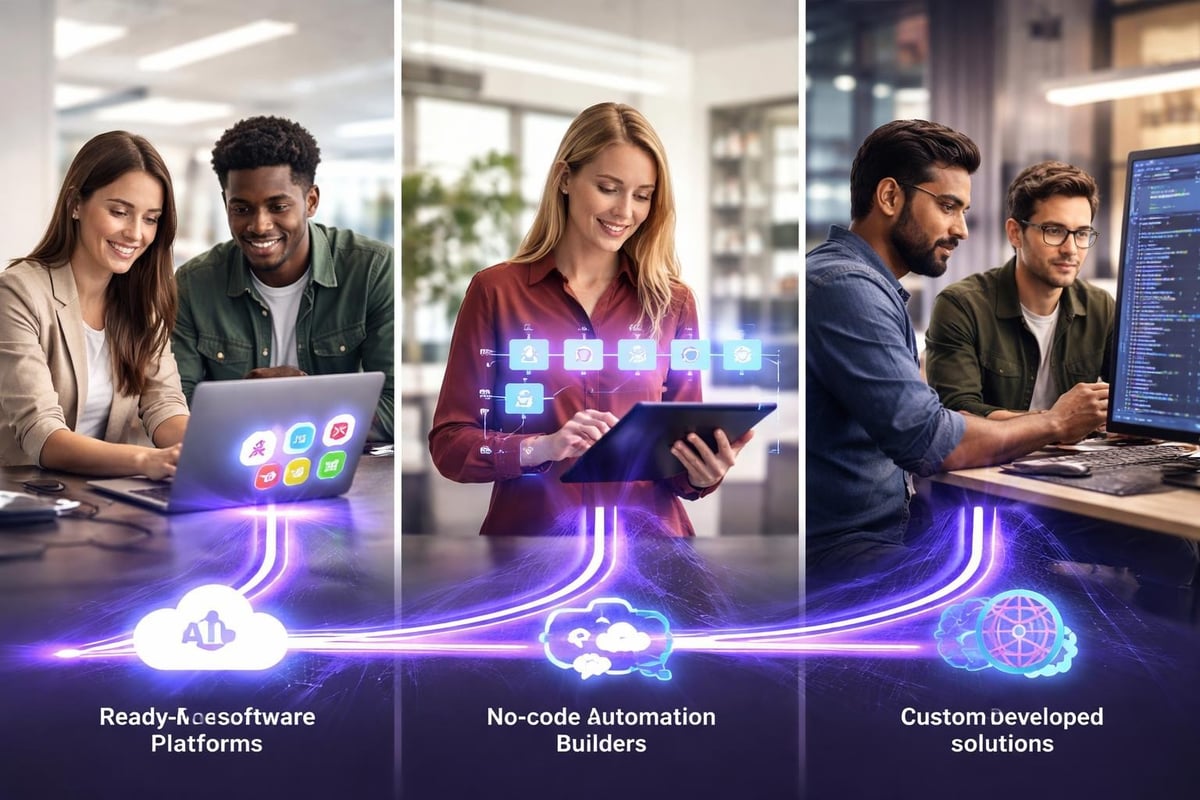
There are essentially three approaches businesses are taking:
- Off-the-shelf AI tools - Existing platforms like customer service software or scheduling tools that have AI baked in
- No-code AI builders - Platforms where you can connect AI models to your existing systems without coding
- Custom AI solutions - Purpose-built tools developed specifically for your business processes
For most small businesses, options one and two deliver the fastest results. A real example of building with AI shows how modern tools make this accessible to non-technical teams.
When you're implementing AI in business, the key is matching the approach to your actual need, not going for the flashiest option.
Sectors Seeing the Biggest Impact
While AI touches every industry, some sectors are seeing particularly impressive results from tools built with AI. Let's look at what's working where.
Retail and eCommerce
Online retailers are using AI for:
- Personalised product recommendations based on browsing behaviour
- Dynamic pricing that adjusts to demand and competition
- Customer service that handles returns, tracking, and product questions
- Inventory forecasting that prevents stock-outs during peak periods
Professional Services
Accountants, solicitors, and consultants are building AI into:
- Document review and analysis (contracts, compliance checks, research)
- Client communication and appointment management
- Time tracking and billing automation
- Research and information gathering
Trades and Field Services
Plumbers, electricians, and construction firms are implementing:
- Automated scheduling that factors in location, skills, and urgency
- Quote generation from photos and descriptions
- Parts identification and ordering
- Job tracking and customer updates
The common thread? Each of these AI tools for work handles the repetitive, time-consuming tasks that don't require human judgement.
What Makes a Good AI Tool for Small Business
Not everything built with AI is worth your time or money. Here's what separates genuinely useful tools from overhyped nonsense:
Does it solve a specific problem? Vague promises about "leveraging AI to transform your business" are red flags. Good tools target specific pain points: "We'll handle your customer enquiries" or "We'll automate your invoice processing."
Can you measure the impact? If you can't track time saved, costs reduced, or revenue increased, it's hard to justify the investment. The best AI tools deliver measurable outcomes within weeks, not months.
Does it fit your workflow? Tools that require you to completely change how you work rarely stick. Look for AI that enhances your current processes rather than replacing them entirely.
Is there a human in the loop? Despite the hype, most effective AI tools work alongside people, not instead of them. Working with AI means finding the right balance between automation and human oversight.
The Hidden Costs to Watch
Beyond the monthly subscription, consider:
- Time needed to set up and train the system
- Integration work to connect with your existing tools
- Ongoing management and maintenance
- What happens if the tool stops working or the company disappears
AI case studies often reveal these hidden factors that make or break implementation success.
Getting Started with AI Tools in Your Business
Right, so you're convinced there's value in tools built with AI. Where do you actually start?
A Simple Framework
- Identify your biggest time-drains - What repetitive tasks eat up hours each week?
- Look for existing solutions first - Someone's probably already built something for your need
- Test before committing - Most AI tools offer trials; use them properly
- Start small and prove value - One successful automation beats three half-finished projects
- Build on what works - Once you've got one win, expand to related processes
This practical approach to AI implementation avoids the common trap of trying to do everything at once and ending up with nothing that works.

The Reality Check: What AI Still Can't Do
Let's be honest about the limitations. Tools built with AI are brilliant at certain things and useless at others. Understanding the difference saves you frustration and wasted money.
AI excels at:
- Pattern recognition across large datasets
- Handling repetitive tasks with slight variations
- Processing information faster than humans can
- Working 24/7 without breaks
AI struggles with:
- Truly creative thinking or innovation
- Understanding nuanced context without training
- Explaining why it made a specific decision
- Handling situations it's never encountered before
This is why AI for business processes works best when you're augmenting human capability, not replacing it entirely. Your team brings judgement, creativity, and relationship skills. AI brings speed, consistency, and scalability.
The Future Is Already Here
Here's the thing: tools built with AI aren't coming to small businesses. They're already here, already working, already delivering results. The question isn't whether to adopt AI-it's whether you'll adopt it proactively or reactively when competitors force your hand.
The businesses seeing the biggest wins aren't necessarily the most technical. They're the ones willing to identify problems, test solutions, and iterate based on what works. They're treating AI as a practical tool, not a magic solution.
The landscape of tools built with AI is expanding rapidly, but the fundamentals remain the same: focus on real problems, measure actual results, and build capability step by step. If you're ready to move beyond the hype and implement AI solutions that deliver measurable impact, AI 4 Small Business can help you identify the right opportunities, select appropriate tools, and build automations that work within your existing business. No jargon, no expensive development-just practical AI that saves time and supports growth.