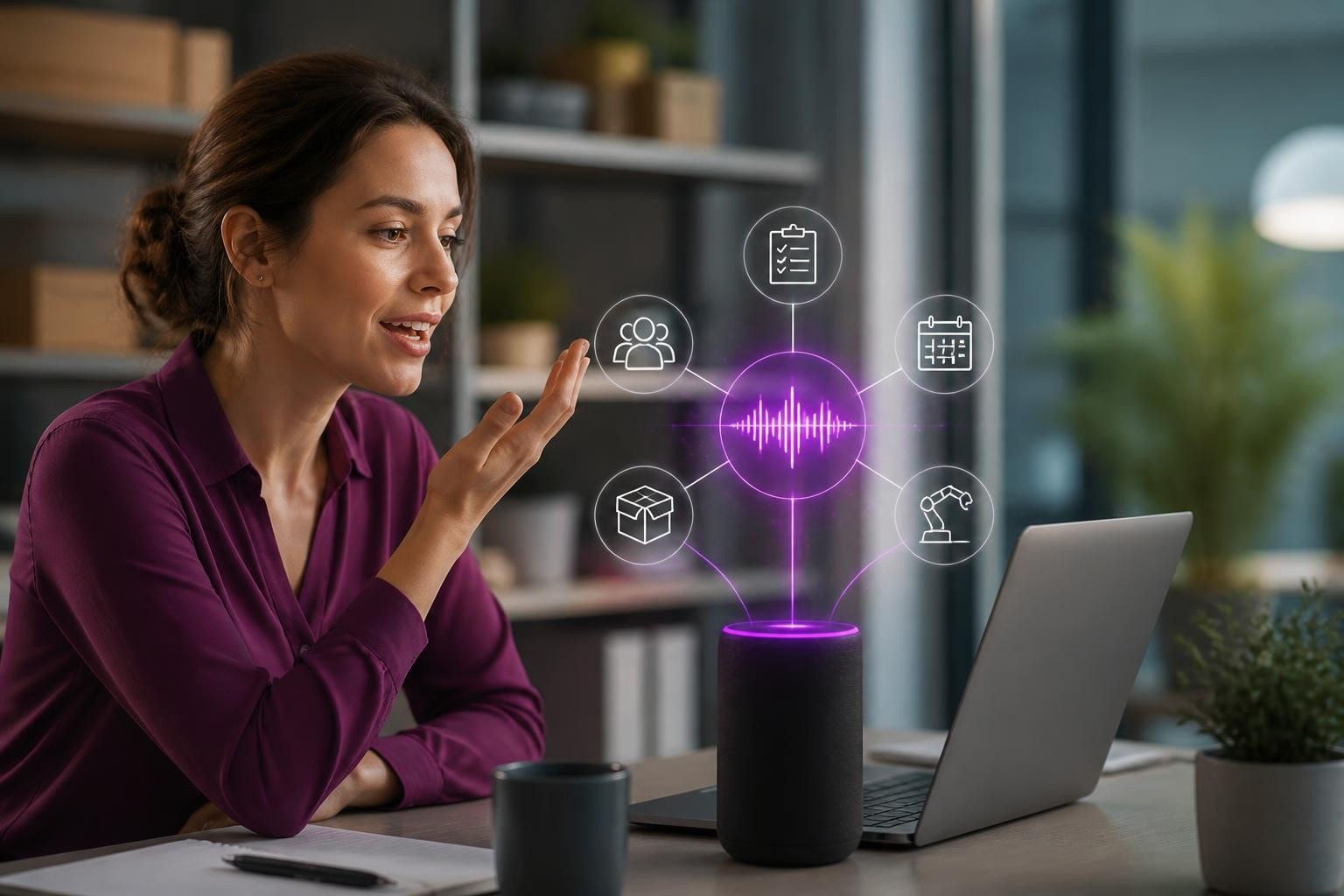
You've probably heard the buzz about AI chatbots, but what about when they're connected to your actual business systems? An erp ai chatbot isn't just another customer service tool-it's a game-changer that connects directly to your enterprise resource planning system, giving you instant access to data, workflows, and processes through simple conversation. For small businesses, this means your team can query stock levels, check order statuses, or pull financial reports without clicking through endless menus or running complex database queries.
The magic happens when conversational AI meets your core business data. Instead of training staff on complicated software interfaces, they can simply ask questions in plain English. This isn't science fiction anymore-it's practical technology that's becoming accessible and affordable for businesses of all sizes in 2026.
Why Small Businesses Need an ERP AI Chatbot
Traditional ERP systems are powerful but notoriously clunky. Your warehouse manager shouldn't need a degree in software navigation to check if there's enough stock for a big order. Your finance team shouldn't spend 20 minutes hunting for a specific invoice.
Here's what an erp ai chatbot solves:
- Speed: Get answers in seconds instead of minutes
- Accessibility: No training manuals or complex navigation required
- Consistency: Same information for everyone, reducing errors
- Availability: 24/7 access to business data without human intervention
The real transformation, as highlighted in this Harvard Business Review analysis, is how generative AI fundamentally changes knowledge work. Your team can focus on decisions rather than data retrieval.

Real-World Applications That Actually Matter
Let's get specific. An erp ai chatbot isn't just about fancy technology-it's about solving real problems you face every day.
Inventory Management Made Simple
Your sales team is on a call with a customer who wants 500 units. Instead of putting them on hold whilst checking multiple screens, they ask the chatbot: "Do we have 500 units of product X in stock?" Instant answer. Order confirmed. Customer happy.
Financial Reporting Without the Faff
Month-end reporting usually means hours of exporting data and building spreadsheets. With a chatbot connected to your ERP, your finance manager asks: "What were our top five expenses last month?" or "Show me outstanding invoices over 60 days." The chatbot pulls the data directly from your financial modules.
Order Tracking for Everyone
Customer service teams spend ages logging into systems to track orders. Now they simply ask: "What's the status of order #12345?" The chatbot queries your ERP, checks warehouse systems, and provides a complete update in seconds.
If you're already exploring custom AI agents for small business, an ERP-connected chatbot is a natural next step that delivers immediate operational value.
Implementation: Keeping It Practical
You don't need a massive budget or a team of developers. The key is starting small and building on what works.
| Implementation Phase | Focus Area | Typical Timeline |
|---|---|---|
| Discovery | Identify top 5-10 most frequent queries | 1-2 weeks |
| Pilot | Connect chatbot to one ERP module | 2-4 weeks |
| Training | Fine-tune responses with real user feedback | 4-6 weeks |
| Expansion | Add additional modules and capabilities | Ongoing |
Start with these questions:
- What information do your team members ask for most often?
- Which ERP modules cause the most frustration or training issues?
- Where are you losing time to manual data lookups?
The Microsoft Copilot for Dynamics 365 documentation provides excellent technical patterns if you're using their ecosystem, though the principles apply regardless of your ERP platform.
Building Trust and Governance
Here's what nobody talks about enough: an erp ai chatbot needs proper guardrails. You're giving conversational access to sensitive business data, so governance isn't optional.
Security First
Your chatbot should respect existing user permissions. If someone doesn't have access to financial data in your ERP, they shouldn't get it through the chatbot either. Simple as that.
Accuracy Matters
Unlike AI-powered assistants that generate creative content, ERP chatbots need to be factually correct 100% of the time. A wrong stock level or incorrect invoice amount causes real problems.

The NIST guidance on trustworthy AI offers frameworks for evaluating and managing risks, which is particularly relevant when deploying conversational AI in business-critical systems.
Key governance elements:
- Audit logs of all chatbot queries
- Clear escalation paths when the chatbot can't answer
- Regular accuracy reviews and validation
- User feedback mechanisms to improve responses
Integration Architecture That Works
You don't need to be a technical expert, but understanding the basics helps you make smarter decisions. An erp ai chatbot sits between your users and your ERP system, translating natural language into structured database queries.
The Three-Layer Approach
- Conversation Layer: Understands what users are asking
- Logic Layer: Translates questions into ERP-specific queries
- Data Layer: Retrieves information from your ERP database
For businesses using SAP, the Generative AI Hub integration patterns demonstrate how modern chatbots connect to enterprise systems whilst maintaining data integrity and security.
This architecture mirrors approaches used by AI workplace assistants, but specifically tailored for ERP data and workflows.
Measuring Real Impact
Numbers matter. You're investing time and potentially money into this technology, so track what actually changes.
| Metric | Before Chatbot | After Chatbot | Impact |
|---|---|---|---|
| Average query response time | 8-15 minutes | 10-30 seconds | 96% reduction |
| ERP training time (new staff) | 2-3 weeks | 2-3 days | 85% reduction |
| Support tickets for "how do I find..." | 40/month | 5/month | 87% reduction |
| Data entry errors | 3-5% | 0.5-1% | 75% reduction |
The Forrester architectural guidance on agentic AI emphasises designing for measurable business outcomes, not just technical capabilities.
Common Pitfalls to Avoid
Let's be honest about what can go wrong, so you can avoid these mistakes:
Over-promising in scope: Don't try to connect every ERP module on day one. Start with the highest-impact, lowest-complexity area.
Ignoring change management: Your team needs to trust the chatbot. If the first answers they get are wrong, they'll never use it again.
Neglecting data quality: A chatbot will only be as good as your ERP data. If your inventory records are a mess, the chatbot will reflect that mess back to users.
Forgetting mobile: Your warehouse staff aren't sitting at desks. They need chatbot access on phones and tablets where they actually work.
Forward-Thinking Approaches
Looking ahead, erp ai chatbot capabilities are evolving rapidly. Research like the agent-based AI frameworks for ERP workflows suggests we're moving beyond simple query-response patterns toward AI agents that can actually execute tasks.
Imagine asking: "Order 200 units of product Y when stock drops below 50" and having the chatbot not just remind you, but actually create the purchase order when conditions are met. That's where we're heading in 2026 and beyond.
For small businesses exploring broader AI digital solutions, ERP chatbots represent a practical entry point that delivers measurable value quickly.
Making It Happen in Your Business
The gap between knowing about ERP AI chatbots and actually having one working in your business comes down to execution. You need to identify your specific use cases, evaluate options that fit your ERP system and budget, and implement with proper testing and governance.
Most small businesses benefit from expert guidance here. Not because the technology is impossibly complex, but because experience helps you avoid expensive mistakes and get to value faster. The right approach focuses on your actual business processes, not just what's technically possible.
An erp ai chatbot transforms how your team interacts with business-critical data, turning complex software into simple conversations that save time and reduce errors. If you're ready to explore how conversational AI can work within your specific business systems and processes, AI 4 Small Business specialises in practical implementations that deliver measurable results. We'll help you identify the right starting point, build solutions that actually work, and create AI capability that supports your growth without creating dependency.