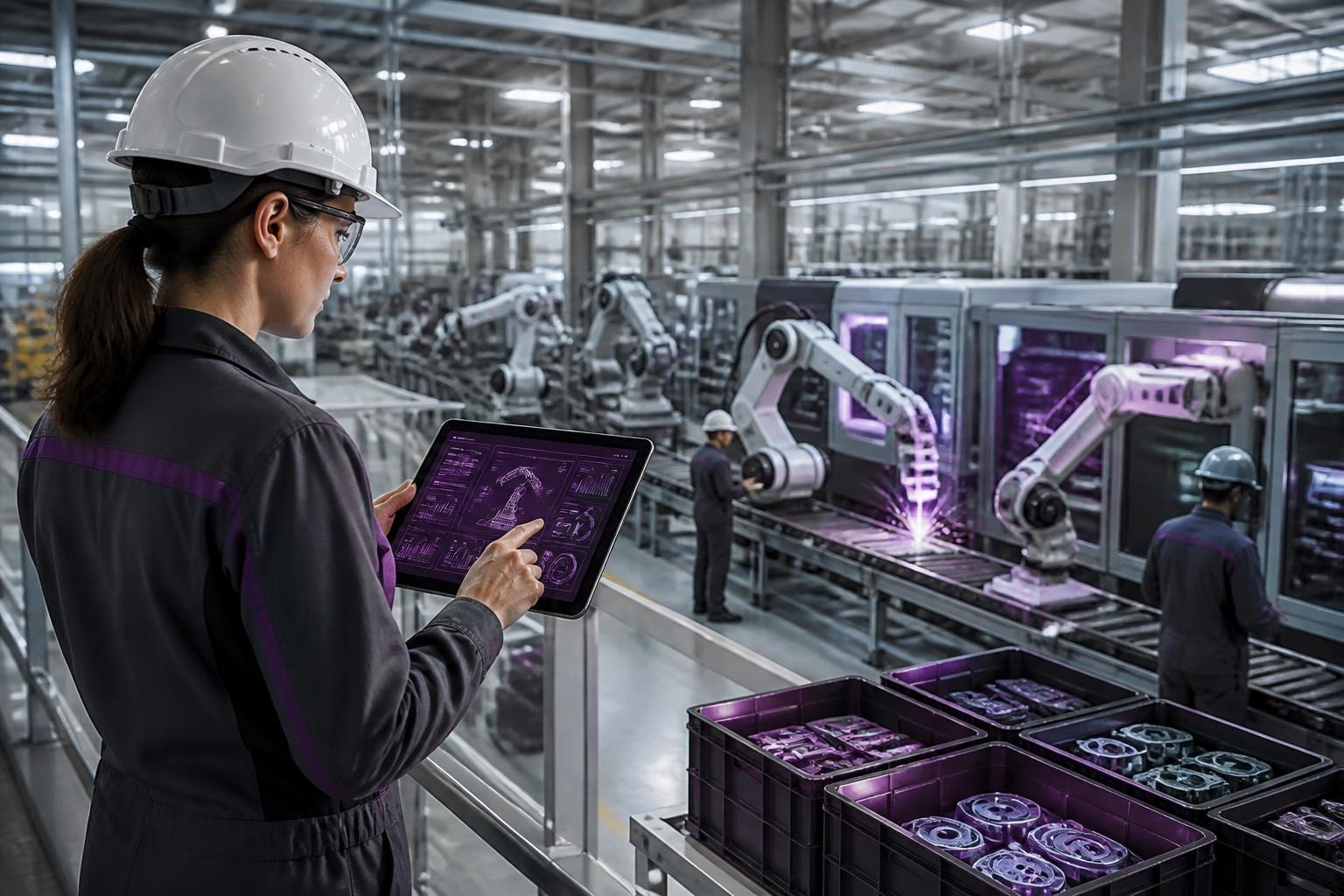
The use of AI in business has moved well beyond the hype stage. It's no longer about whether small businesses should adopt AI, but how to implement it in ways that actually deliver results. You're probably tired of hearing vague promises about AI transforming everything whilst struggling to see what that means for your day-to-day operations. The truth is, AI isn't magic-it's a practical tool that works best when you apply it to specific, time-consuming processes that drain your resources. Let's look at what's actually working for businesses in 2026.
Where AI Makes an Immediate Difference
The most successful implementations we see aren't the flashiest ones. They're the unglamorous tasks that eat up hours every week.
Invoice processing is a perfect example. You've got invoices arriving by email, through your portal, sometimes even by post. Someone needs to open them, check the details, enter them into your accounting system, and chase approvals. AI invoice processing can extract data from any format, validate it against purchase orders, and route for approval-all without human intervention.
Customer service is another area where the use of AI in business shows immediate returns. You're getting the same questions repeatedly: order status, opening hours, return policies. An AI chatbot handles these instantly, 24/7, whilst escalating complex queries to your team. That's not replacing people-it's freeing them to focus on situations that actually need human judgement.

Real Applications Across Different Sectors
Let's get specific about how different businesses are using AI right now.
Retail and eCommerce:
- Inventory forecasting based on sales patterns, seasonality, and trends
- Personalised product recommendations that actually increase basket size
- Automated stock reordering when levels hit specific thresholds
- Customer sentiment analysis from reviews and social media
Trades and Construction:
- Quote generation from photos and measurements
- Job scheduling optimised around location, skills, and availability
- Material cost tracking and supplier price comparison
- Safety compliance monitoring through image recognition
Professional Services:
- Document analysis and contract review
- Client communication scheduling and follow-ups
- Time tracking and project profitability analysis
- Research summarisation and insight extraction
What separates successful implementations from expensive failures? According to research from Boston University, it's not about having the fanciest tools-it's about proper execution and integration.
Starting With Process, Not Technology
Here's where most businesses get it wrong: they start by looking at AI tools instead of their processes. That's backwards.
Your first step should be mapping out what actually happens in your business day-to-day. Which tasks take the longest? Where do bottlenecks form? What requires multiple people to complete simple actions?
| Process Type | Time Impact | AI Suitability | Typical ROI Timeframe |
|---|---|---|---|
| Data entry | High | Excellent | 1-2 months |
| Email management | Medium | Good | 2-3 months |
| Report generation | Medium | Excellent | 1 month |
| Customer queries | High | Good | 2-4 months |
Once you've identified your time-drains, you can match them to AI capabilities. Working with AI means understanding what it's genuinely good at-pattern recognition, data processing, and rule-based decisions-rather than forcing it into areas where human judgement is essential.
The use of AI in business delivers the best results when you're solving a clear problem, not implementing technology for its own sake. IBM's research on AI benefits reinforces this: businesses that start with measurable objectives and work backwards to the technology see significantly better outcomes.

Building Capabilities Without Creating Dependencies
There's a massive difference between using AI tools and becoming dependent on external providers for everything. You want to build internal capability, not just outsource your thinking.
Start small with tools your team can actually use. No-code automation platforms let you connect your existing systems-your CRM, accounting software, email-without hiring developers. You can set up workflows that trigger actions based on specific events.
Simple automations to start with:
- New customer enquiry → Add to CRM → Send welcome email → Notify sales team
- Invoice received → Extract data → Match to PO → Route for approval
- Support ticket created → Categorise by type → Assign to relevant team member
- Low stock alert → Check supplier prices → Generate purchase order
These aren't revolutionary, but they're concrete examples of AI business automation that save actual hours every week.
Measuring What Matters
You can't improve what you don't measure. Before implementing any AI solution, establish your baseline metrics.
How long does your current process take? How many errors occur? What's the cost per transaction? Then track the same metrics after implementation.
According to Qualtrics data on AI usage in 2025, businesses that measure properly see clearer ROI and make better decisions about where to invest next. The use of AI in business isn't about transformation for its own sake-it's about measurable improvement.
Common Pitfalls and How to Avoid Them
Let's talk about what doesn't work. You've probably heard stories about failed AI projects that cost a fortune and delivered nothing.
The biggest mistakes:
- Implementing AI without training your team properly
- Choosing complex solutions when simple ones would work
- Not cleaning your data before feeding it into AI systems
- Expecting AI to fix broken processes instead of efficient ones
- Following trends instead of solving your actual problems
Your data is the foundation. If you're feeding messy, inconsistent data into an AI system, you'll get messy, inconsistent results. That's not an AI problem-it's a data problem.
TechTarget's analysis of key AI benefits shows that successful implementations start with data quality and clear use cases, not technology selection.

Practical Next Steps for Your Business
So where do you actually start? Here's a straightforward approach that works.
Week 1-2: Document your most time-consuming processes. Get your team involved-they know where the pain points are. Look particularly at tasks that happen repeatedly, follow predictable patterns, and don't require complex decision-making.
Week 3-4: Research what's already available. You don't need custom development for most use cases. Off-the-shelf tools have become incredibly capable. Check out practical AI use cases relevant to your sector.
Week 5-6: Run a pilot with one process. Keep it small and measurable. If you're automating quote generation, test it alongside your current process. Compare speed, accuracy, and customer response.
Week 7-8: Gather feedback, adjust, and decide whether to scale or pivot to a different process.
The beauty of this approach is you're learning as you go. You're building understanding within your team about what AI can and can't do. That knowledge is more valuable than any single tool.
Different sectors will find different applications most useful. For instance, AI predictive analytics for retail focuses heavily on inventory and demand forecasting, whilst AI in distribution prioritises route optimization and warehouse efficiency.
Getting Expert Support When You Need It
There's absolutely nothing wrong with getting help. In fact, it often accelerates your results and helps you avoid expensive mistakes.
The question isn't whether to get support, but what kind. You want partners who focus on implementation and results, not just advice. Look for people who've actually built these systems, who understand your sector, and who can point to concrete outcomes.
When evaluating whether you need external support, consider your approach to implementing AI. Do you have the internal expertise to evaluate tools properly? Can you integrate them with your existing systems? Do you know how to measure success accurately?
The use of AI in business works best when you combine external expertise with internal ownership. You want to learn, not just delegate. Building that capability means you can scale and adapt as your needs evolve.
AI in business isn't about wholesale transformation-it's about identifying specific, time-consuming processes and implementing tools that deliver measurable results. The businesses seeing real returns in 2026 are the ones taking a practical, focused approach rather than chasing headlines. If you're ready to implement AI solutions that actually work for your business, AI 4 Small Business helps you identify the right opportunities, select the appropriate tools, and build automation that delivers fast, measurable impact without the jargon or expensive custom development.